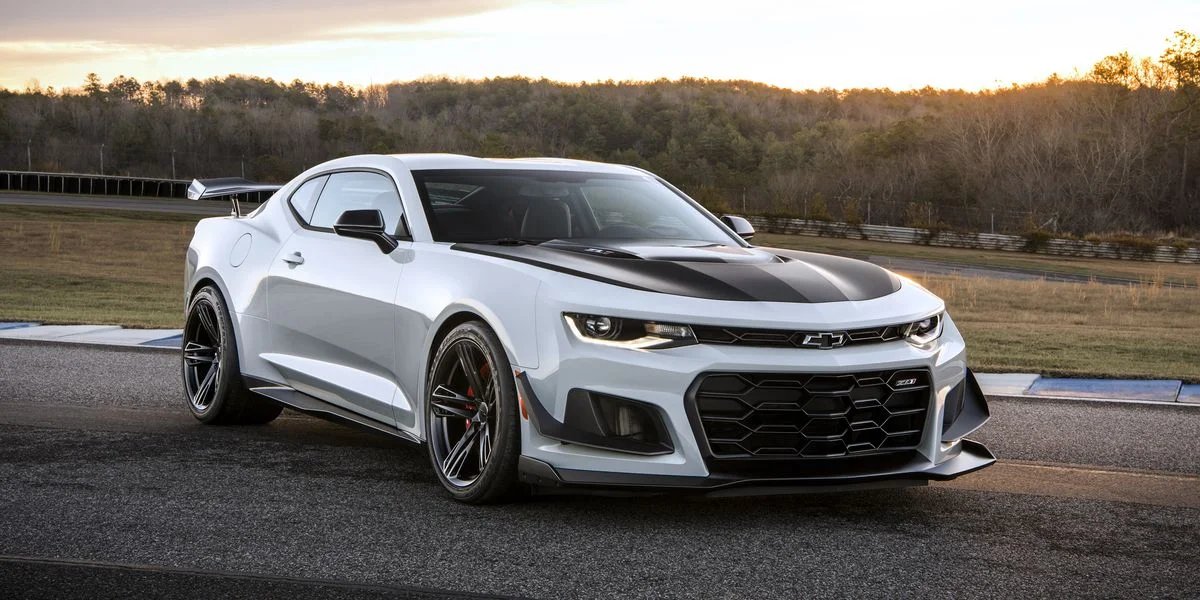
The sporty Chevrolet Camaro was developed in the mid-1960s in America as an alternative to the Ford Mustang model.
The first generation Chevy Camaro appeared in 1966 and was a great success. A total of four generations were released, and in 2002 production was discontinued. The latest Camaro made a resurgence in the US market a few years ago. At first, the manufacturer – General Motors – announced that the model will be supplied only to the American market, with a choice of 6 or 8 cylinder engines. Therefore, the news that the Camaro will come to Europe came as a surprise. This is apparently due to the success of the Camaro across the Atlantic: according to the latest data, almost 80 thousand of this model have already been sold in 2011, while the main competitor, the “Mustang”, has much more than 10 thousand. fewer copies. Ford had also discontinued the Mustang, but its fifth generation returned to the market in 2005, and a year later the GM company presented the concept of the future Camaro. When the production version of the fifth generation Camaro was announced, it was thought that it would be different from the concept model, but in 2009 the debut proved that the Camaro appeared on the market almost unchanged.
For Europe – only with V8
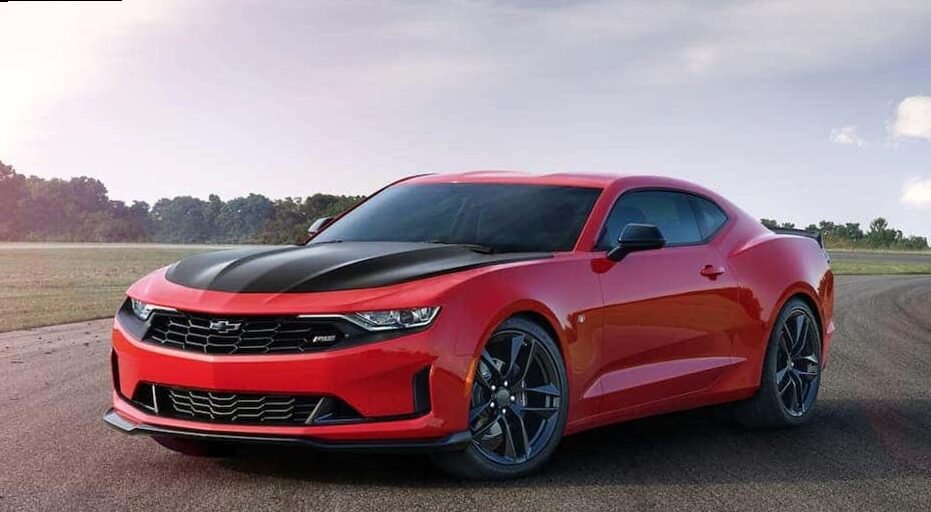
When my colleagues and I went to test the Camaro in Croatia, we already knew that this model would only be offered in Europe with V8 engines. It seemed that this car drank gasoline in buckets, since sports “racing cars” are offered: – with a single 6.2-liter naturally aspirated V8 power unit, which, depending on the transmission, can be two-power. The version with manual transmission delivers 432 HP, a maximum torque of 569 Nm (at 4600 rpm). The Camaro equipped with an automatic transmission has 405 HP and reaches a maximum torque of 556 Nm (at 4300 rpm). According to representatives of the manufacturers, economy is definitely not the most important priority: the model with manual transmission has an average fuel consumption of 14.1 l/100 km, with the “automatic” one it is slightly lower. Smaller because in this modification there is a special system in which the automation disconnects four cylinders when the engine is in “easy mode”. The Americans didn’t even think about ecology, because CO2 emissions are three times higher than those required by the latest European standards. Acceleration up to 100 km/h. – in 5.2 seconds, and the top speed is electronically limited to 250 km/h. But the whole “spirit” of this model is that of the 60s.
Not the largest district
After extreme testing on the track, fuel consumption was only around 16 l/100 km. This was surprising, because in this case similar “bolides” pump at least 20 liters each.
Apparently, the purely American version with a V6 engine is much cheaper. The price of the latter, by the way, is not at all similar to the sports “racing car”: only about 60 thousand. LTL, while the cheapest European version costs over 130 thousand. Lieutenant. According to representatives of the manufacturers, the exact prices for buyers from the Baltic countries will be determined on a case-by-case basis, because the new Camaros will not be sold like hot cakes: we have neither the nostalgic traditions of driving “sporting Americans”, nor too much money. It seems that this model should be much more popular in Scandinavia, where American sports cars were available even in the hippie era… Meanwhile, more and more people will buy used “sports” brought from the USA here for relatively little money.
It has a unique character
Coupe and cabriolet body styles are available, as well as a special 45 version, created for the 45th anniversary of the model. It differs only in some specific decorative accents. If driving a coupe is the same as other similar cars, then, say, the roof of the convertible can be raised only in especially good weather: the aerodynamics of this version are similar to tragic, the wind blows from all sides. The same can’t be said for many European convertibles. The seat is low, rear visibility is tragic, but this is also the case with similar cars.
I was surprised by the Camaro’s suspension, which is no fake wooden stool. Camaro has a special “softness”. Wheels – as if they were of a real “bolide”: 20 inches with Brembo brakes. Drive axle – rear. The imbalance between the front and rear axles is distributed in the ratio of 52:48.
The exterior is as it should be: a long hood and a short end, modernized by LED taillights and curves. The interior is not at all similar to the “cheap” ones that dominated American sports cars: the plastics are not entirely noisy, there is even a USB interface, speed and other data are displayed in yellow on the windshield.
This has already been seen in European models, BMW did it first. There is also ballast: near the gear lever there are at least 4 indicators showing completely useless things: oil pressure, etc. Only two small passengers can sit comfortably in the back of the car, you can hardly find taller ones there…
RELATED POSTS
View all


The 5 best motorcycle garages in Paris in 2025
December 15, 2025 | by EngineGeek Editorial
Choosing a paint shade | Monochrome enamels require
February 12, 2026 | by EngineGeek Editorial