
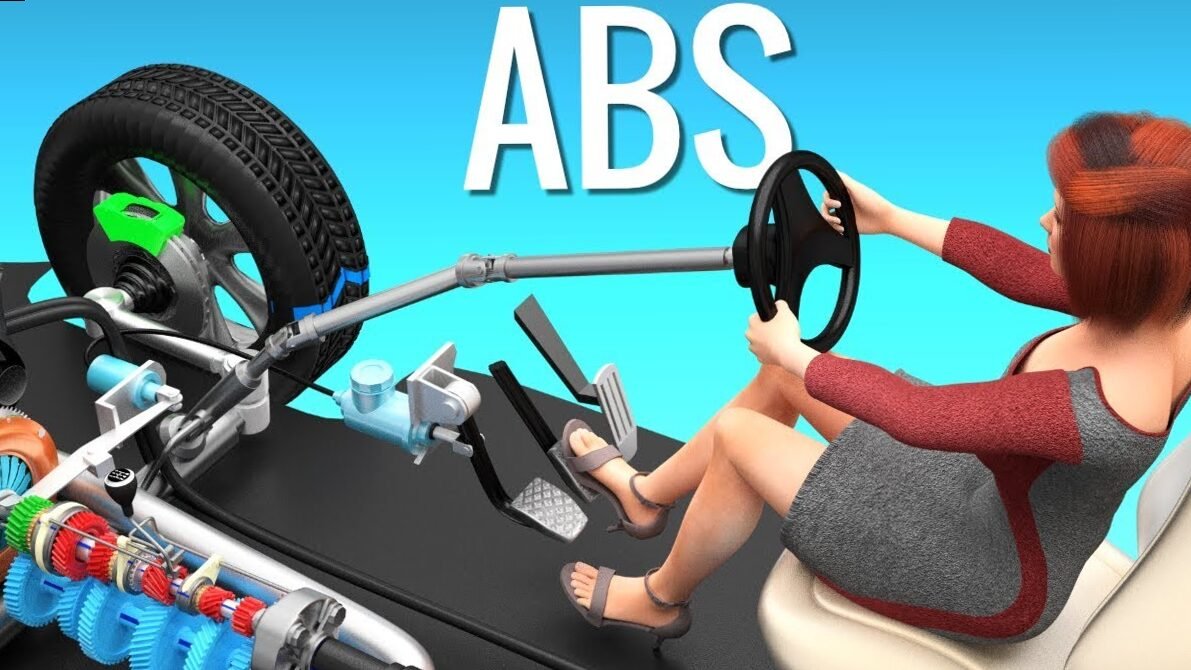
Anti-lock Braking System (ABS) was developed in 1978, but it wasn’t applied to passenger cars until about a decade later. It helps a vehicle stop optimally regardless of road conditions. The grip of the wheels on the road depends on the road surface and the tires. Without ABS, lateral forces are generated during braking, causing the vehicle to slide sideways. Therefore, the braking torque of each wheel must be monitored to ensure a safe stop. Vehicles equipped with ABS can still steer during braking because the system prevents wheel lock-up. Some newer vehicles also feature Electronic Brakeforce Distribution (EBD).
When braking on wet or slippery surfaces, some or all of the wheels may lock up. ABS prevents this and offers the following advantages:
• the vehicle maintains control, despite increasing braking and lateral forces;
• has the shortest stopping distance (good controllability and stability allow the stopping distance to be shortened);
• Tire wear is reduced, but brake pads and discs wear faster.
The rotation frequency of the wheel is usually measured by inductive sensors. The signal from the sensors is transmitted to the control unit with an alternating voltage, the signal of which is directly proportional to the rotation frequency of the wheels. When you brake the vehicle gently, the wheels slip only slightly and do not lock. In high-slip situations, ABS is required to prevent the wheels from locking. When there is a danger of the wheel locking, the corresponding electromagnet reduces the braking pressure – it controls the braking moment of the wheel so that its slip is not more than 5%. As slip increases (worsening grip conditions), the pressure in the braking system is reduced. When the wheel turns faster, the slip decreases and the pressure in the brake system increases again.
Does not allow rotation
The car’s traction system TCS (traction control system), in German – ASR (Antriebs-Schlupf-Regelung), improves the stability of the car when accelerating on any surface. This system was created in 1985. It prevents one or more driving wheels from slipping when more torque is transmitted to them when the car drives on any road with low or variable traction.
TCS increases traction when starting or accelerating when the traction coefficient is low or the wheels roll on different road surfaces.
The TCS system can work in several ways: reducing engine speed, braking the drive wheels, or both.
Improves stability
The ESP driving dynamics control system helps not to lose the stability of the driving trajectory when cornering. This system was created in 1995. The electronic stability control system ESP (electronic stability program) improves the stability of the car.
Unlike ABS or TCS systems, which work when the car brakes or accelerates, ESP works continuously. This system “monitors” the angle of the steering wheel, the speed and acceleration of the car with special sensors.
If the car’s trajectory does not correspond to the turning curve, the ESP system slows down one or more of the car’s wheels. If the car swerves sideways, the system will instantly adjust the braking force on the front axle until the car regains stability. Furthermore, in the event of insufficient maneuverability of the car when cornering, the ESP system will automatically adapt the braking force to the inside wheel of the car and thus ensure the stability of the vehicle in bends in the road.
This system can not only brake one or more wheels, but also change their torque, adjust the engine speed and other operations.
Maximum safety
Collision Avoidance System (CMBS). Safety is guaranteed by an additional brake mechanism with integrated radar sensors and the latest generation PRE-SAFE or CMBS safety systems. Accident prevention is improved by installing an additional braking system (Brake Assist Plus).
The radar system detects cars ahead and warns the driver if the distance to the nearest car is too short or if he is approaching it at too high a speed. If a collision is imminent, the system calculates the ideal braking distance with an accuracy of a fraction of a second and brakes the car optimally, even if the driver presses the brake pedal too weakly.
The specially adapted rear brake lights also effectively protect against collisions: they start to flash in the event of emergency braking, thus warning drivers behind.
If the braked car slows down too quickly or swerves dangerously, the system takes precautionary measures by tightening the front seat belts, inflating parts of the seats and adjusting them to ensure the safety of the driver and passengers. One of the measures of the security system is the automatic closing of windows.
Other systems
EBA (Emergency Brake Assist) emergency braking system. This system reacts instantly to a sudden pressure on the brake pedal and maximizes braking force.
According to the manufacturers, when driving at 200 km/h. speed, a car equipped with EBA stops even 22 meters closer than a car without this system.
A system that protects the drive wheels from slipping when a lower gear is engaged – MSR (Motor schleppmoment distribution).
When driving on a road with poor wheel grip, shifting into a lower gear that increases engine speed prevents the wheels from overbraking and skidding, thus reducing the chance of losing control of the vehicle.
DSTC dynamic stability and traction control system. Improves driving stability on slippery roads by equalizing the rotation of the driving wheels and, if necessary, modifying the forces.
In addition, the system compares the vehicle’s direction of travel with steering wheel movements. If necessary, the system reduces engine power or brakes individual wheels to reduce wheel slippage.
The system can be set to provide additional traction on snowy roads.
Adaptive Cruise Control (ACC) maintains a constant speed.
If an obstacle is detected ahead, the system prioritizes maintaining a safe distance from the vehicle in front. If no obstacle is detected, the system resumes the set speed.