


Innovation in vehicle safety testing: trucks will be classified
January 23, 2026 | by EngineGeek Editorial
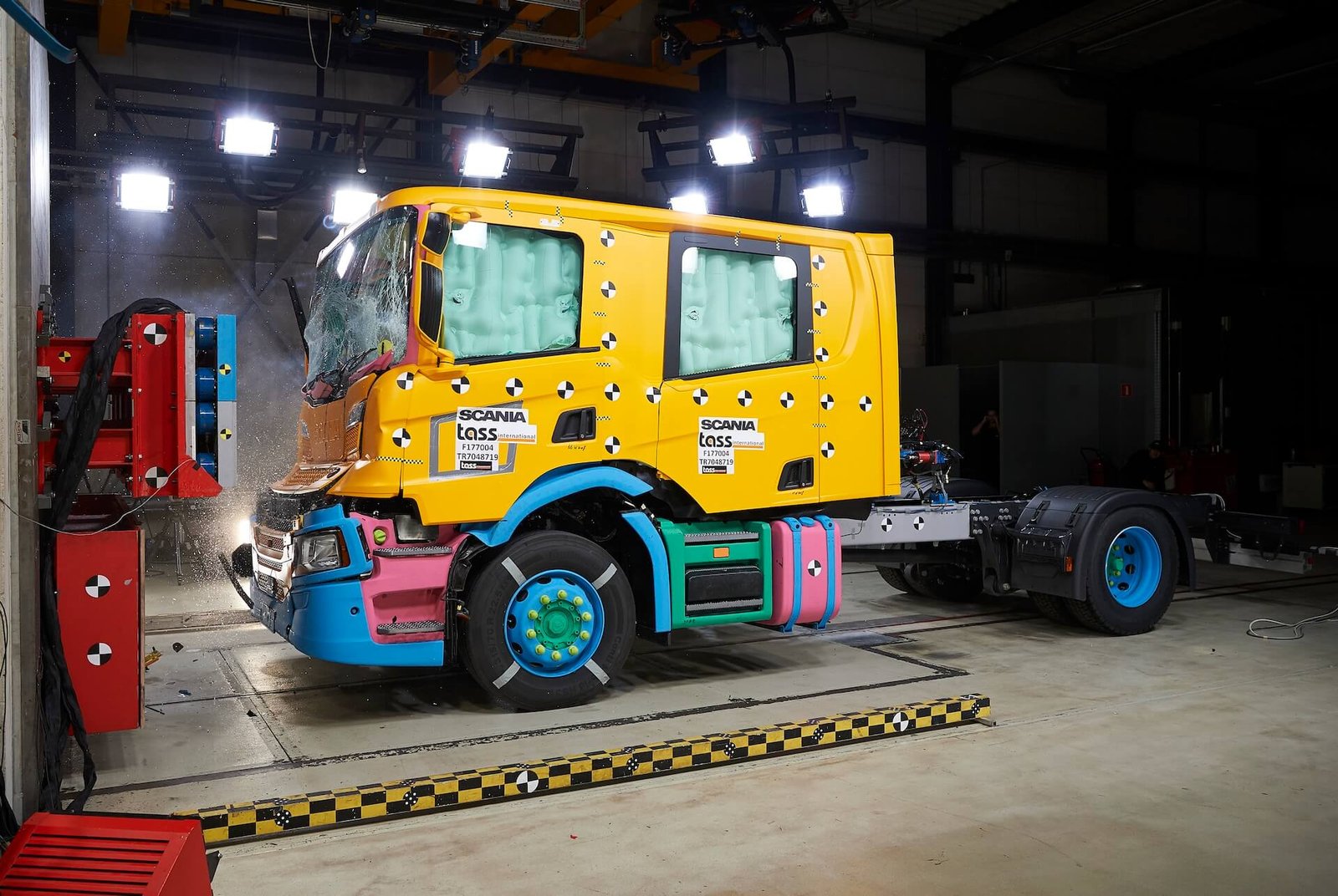
Although truck manufacturers receive lists of vehicle safety systems to be installed long before car manufacturers, it is puzzling that there is currently no formal or legal obligation requiring truck manufacturers to conduct such testing.
In 2023, a system designed to compare the safety of different trucks began development. Manufacturers, transportation companies, and road engineers should prioritize safety when creating a safe environment for all road users.
Swedes welcome the decision
Swedish manufacturers, who have historically always made safety a priority, welcome this decision and safety standards for new cars, including trucks, are the highest in this country.
Scania has already officially declared its support for the initiative because, according to them, ambitious companies that invest in safety will have additional arguments to justify the reliability of their products. These things are very important in the passenger car segment. A similar turnaround is expected in the truck market.
According to Euro NCAP calculations, trucks account for 1.5%. of all vehicles circulating in Europe, but they fall within 15%. fatal accidents. The main reason for this is that trucks travel more kilometers than cars (sometimes up to 10 times). However, until now there has been no common system for evaluating the safety of trucks.
Security tests are of great interest not only for the first results, but also for the process itself. The tests will be much more difficult than for cars, because the production of trucks is extremely limited by various regulations: weight, length, speed, driving time etc., which affect their design, construction and, of course, safety.
For example, to check whether the safety elements work properly, the Scania company crashed some trucks in its workshops on its own initiative. Although this is a significant investment for the manufacturer, it is necessary to communicate as much information as possible to the engineers.
At the beginning, several collisions are simulated with the help of a computer. Different speeds and collision angles are set. Then, if necessary, the individual parts are compressed. Finally, in the laboratories a real collision is created between a truck and another vehicle.
A collision lasting a few seconds should confirm the results of months of work in simulators. To reproduce possible situations as accurately as possible, real cars are not used as obstacles.
Electric and methane-powered Scania trucks undergo further impact tests. Batteries and compressed gas tanks receive direct shocks to ensure they can withstand the most severe operating conditions and prevent accidents.
Invisible heroes
Many are familiar with long-standing safety attributes such as seat belts or ABS. However, there are also a number of young, rising safety stars that have been installed in cars for years. Systems monitoring road and lane markings, emergency braking, tire pressure and driver attention are no longer surprising. However, trucks have other, less obvious, but equally important safety features.
For example, thanks to the special cab structure of Scania tractors, impact forces are distributed in the safest directions for road users. It also prevents smaller vehicles from going under the truck.
The cab itself is designed to offer the driver excellent front and side visibility: slimmer pillars, the position of the instrument panel and activated night lighting improve visibility and prevent reflections. Visibility is also improved by the 360-degree panoramic image: cameras connected to a system show everything that happens around the truck. And side curtain airbags protect against injuries if the truck tips over on its side.
Special sensors detect objects in the “blind zones”. In risky situations, LED light emitting diodes installed in the A-pillars inform the driver. Furthermore, on the instrument panel, the driver can see in real time how braking, acceleration, gear changes and other driving elements affect not only fuel consumption, but also road safety.
The electronic stability system (ESP) deserves special attention. It is much more complicated than the one installed in passenger cars, so it requires more work. Especially when the truck is equipped with a semi-trailer. On wet and slippery road surfaces, the system correctly corrects steering too much or too little. In good condition, it prevents overturning due to excessive speed. Without this system, any driver failure could be catastrophic.
Another technology implemented in trucks is Adaptive Cruise Control (ACC) which allows you to avoid getting too close to a slower moving vehicle. When the road clears, the default constant speed is restored.
The size of the truck and the space it requires on the road are the reasons why both old and new assistance technologies are vital for the driver. Numerous security systems, sensors and cameras do invisible but very significant work.
However, good driving skills and alertness remain an essential part of safe driving. Even professional drivers must constantly improve their skills in order to effectively exploit the advantages of high technology in heavy transport.
RELATED POSTS
View all


An automotive “garage” with an unusual concept has opened its doors in the capital
January 23, 2026 | by EngineGeek Editorial


Intelligent tires will save fuel, ensure safety on the road and report their conditions
January 23, 2026 | by EngineGeek Editorial