


The problem of (NOT) suitable tires. How to avoid losses?
January 23, 2026 | by EngineGeek Editorial
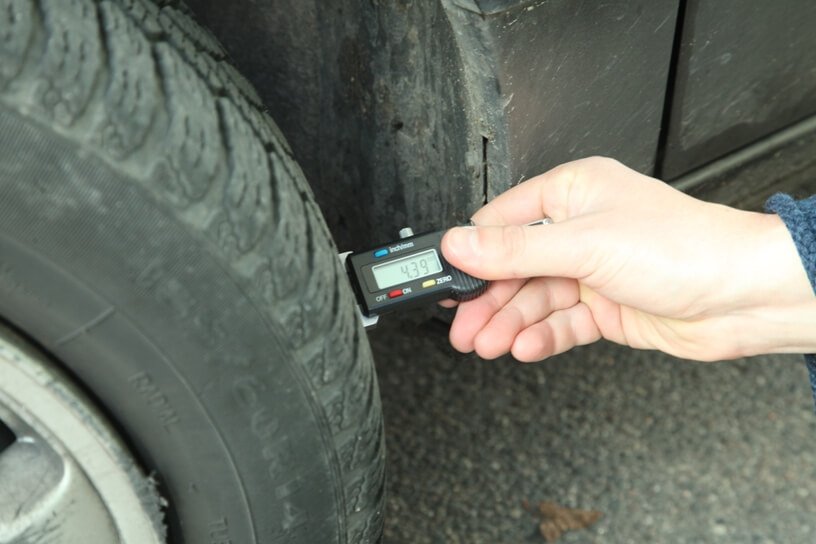
The official farewell to sleet-marked summer tires traditionally exposes the most painful problems of automotive “shoes”. Such traffic conditions, which we see outside the window in recent days, drastically change the length of the braking distance and the ability to control the car, if trips are continued with very worn summer or winter tires (i.e. with a tread depth of less than 4 mm). In both cases, the tires perform their functions very poorly, so the accident indicators increase.
The problem of (NOT) suitable tires. How to avoid losses?
Deputy director of the Tauragė TAC, JUSTINAS AURYLA, responding to the LRT radio program “Sankryža” (the entire interview can be listened to here): noted that this year alone almost 7,000 cars arrived for mandatory technical inspection, whose tire tread depth did not meet the prescribed requirements. In another 4,400 cases the tires showed serious mechanical damage, thus putting road safety at risk, and over 4,000 drivers were traveling with different types of tires mounted on the same axle. In more difficult conditions, such a car becomes difficult to control. Two and a half thousand vehicles that visited TA had incorrect measurements, tires with a different load index or tires that did not correspond to the intended use.
All such things are considered by TAC inspectors as “serious defects” and in some cases even ban the use of the car. Bearing in mind that such problems are not detected during random checks on the road, but in preparation for a scheduled visit to the TAC, one can only imagine how “lenient” drivers consider the state of their vehicles during daily trips…
That in some cases such problems are simply starving, is evidenced by the technical inspection protocols canceled by traffic police officers: in 10 months of this year, 826 sanctions of this type were applied. On over 52 percent of cases of tire non-compliance.
Representatives of insurance companies remind us that in the event of an accident in winter conditions, which is why officials or experts identify insufficient tire tread depth, such an event will be recognized as uninsurable, and in the case of compulsory civil liability insurance of drivers, payment will be collected from the insured person. It is clear that in many cases the price of even the most expensive winter tires is less than the losses incurred in accidents caused by an out-of-control car on a slippery road.
The most important things to know about winter tires:
- According to road safety experts, broken suspension and inoperable tires are the third most important factor among technical car defects that cause accidents on the road. The first and second places are occupied by faulty brakes and broken steering mechanisms.
- Tires that are not suitable for use can be not only worn, but also new, but of poor quality. The price of a set of winter tires belonging to the so-called “budget” segment is around 300 euros. “Lietuvos draudimas” calculates that in case of snow or ice the dominant minor accidents lead to losses of 1,000 euros on average. Taking into account the fact that the obligation to drive winter tires lasts 150 days, and the vast majority of motorists in our country use such tires for at least two seasons – 300 days. Therefore, for four new winter tires during this period, only 1 euro per day should be allocated.
- The Baltics are traditionally classified as a region of Northern Europe, but in reality traffic conditions in Scandinavia are significantly different from those usually encountered in Lithuania. It snows two to six times less than in Finland, and the structure of the snowflakes is also different. The long-term average temperature in January in our region varies between 4 and 4 degrees Celsius, while in northern Scandinavia it rarely drops below 10 degrees Celsius. It is clear that the tasks that tires have to solve in winter are usually completely different in different regions.
- The needs of motorists are very different, so when choosing new tires you need to consult qualified specialists and analyze how much and on which roads you will have to drive, whether you will have to travel in Western or Northern Europe, etc. The decision depends on this: non-studded hard rubber compound, non-studded or studded tires with hard rubber compound.
- Studded tires are the safest in almost all winter conditions and have the only obvious disadvantage: they make more noise (by about 3-5 decibels). However, they are a little more slippery when driving on dry asphalt. Furthermore, nails have a more aggressive effect on the asphalt surface and road markings (lines and signs on the asphalt), so they cannot be used in all foreign countries. When driving on snow or ice, the braking distance of studded tires is about 37 meters, while the best non-studded tires are about 57. Even comparing the cheapest studded tires with the best non-studded tires, the latter lose almost 4 meters in the braking duel. In “Scandinavian” traffic conditions, studded tires reduce the likelihood of accidents by up to 40%.
- The tread blocks of studded tires are more massive and much stiffer, the tread is often “rougher”, so the car is more stable when cornering, their mileage is at least 30%. larger, they repel water better, they “clean” in case of drizzle, therefore they have better grip on the road surface. Cars usually wear these shoes for 3-5 seasons.
- When choosing this type of tires, you have to accept the fact that fuel consumption will be 4-8%. the larger ones.
- For drivers who live in large cities, travel mainly on well-maintained highways or regularly travel to the southern countries of the Old Continent (studded tires are also prohibited in Poland), it is more rational to choose studless tires with solid rubber compound.
- Non-studded tires with a soft rubber compound with many sipes allow you to travel safely on snowy roads, but when driving on clean (or wet) asphalt, they do a disservice: due to the lower overall resistance of the tread, the car begins to “float” under the influence of centrifugal forces, and the stopping distance becomes longer.
- Another factor that reduces the attractiveness of the latter type of winter tires is their extremely high wear rate. To prevent such tires from freezing in the cold, extremely soft rubber compounds are used, so a millimeter of the tread wears out about two to three times faster than on stiffer studded or non-studded winter tires. For cars with a more or more aggressive driving style and powerful engines, they will hardly be enough for a season. In the meantime, intelligently when driving, the stiffer non-studded tires should last 2-3 seasons.
- The operating principles of winter tires do not differ substantially from summer ones. It is necessary to monitor tire pressure and tread wear. If the depth of the tread pattern differs by more than 1 millimeter, it is recommended to move the wheels from the front to the rear axle. This procedure should be performed every 10,000 km. km It is also recommended every 5-7 thousand. km change tires “crosswise” – left front side with right rear side and right front side with left rear side – this is especially relevant for cars with powerful engines, rear-wheel drive cars, which are most often affected by uneven tire wear, called “stepping”.
- It is complete stupidity to ride wide low profile tires in winter. This is in no way compatible with a good grip. (Use only the tire size recommended by your car manufacturer.)
RELATED POSTS
View all


Ford presents the even more solid-looking Fiesta hatchback and the sporty Fiesta ST
January 23, 2026 | by EngineGeek Editorial

the American market full of appetite
December 16, 2025 | by EngineGeek Editorial

Everything you need to know about CMR insurance
December 15, 2025 | by EngineGeek Editorial