
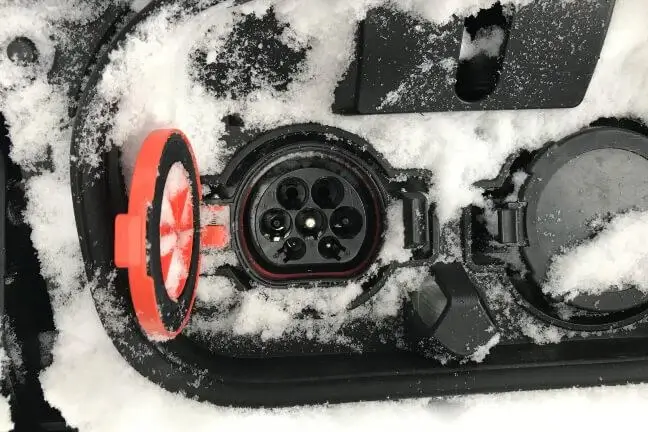
How does air temperature relate to charging speed?
Charging speed depends on many factors, but is mainly influenced by the charge level and battery temperature. These changes even managed to get a special term: “cold-gate”. For example, the electric car “Volkswagen ID.3” can theoretically charge with a maximum power of 175 kW, but when the temperature drops to -15 °C, the charging power can only reach 40 kW. However, the charging speed changes not only when the temperature drops below 0°C, but also when the air cools to around +10°C. Motorists who don’t know this, when they notice changes in charging speed, first think of possible faults in the charging station or power limitations.
In order for the electric car to charge quickly even in cold weather, it is necessary to maintain the optimal battery temperature. Depending on the electric car model, the optimal battery temperature varies from 25 to 50 °C. Therefore, when it gets colder outside, the battery needs additional heating.
Warming up the battery takes time and consumes energy
When charging an electric car in cold weather, it takes about 20-30 minutes to warm up the battery, and additional energy is used for this process. This is evident during the charging session: when the session starts, the station and the electric car display will show a different instantaneous power. In most cases, the power will be higher at the station than on the display of the electric car, because the energy is used not only to recharge the battery, but also to heat it. For this reason the electric car charges a greater amount of electricity than the battery capacity.
There are electric cars that start the charging session only when the minimum battery temperature is reached. In this case, you may have to wait 10-15 minutes for the charging session to begin.
It is worth knowing that the more efficient the battery, the longer the heating time will be. This trend is particularly felt when charging electric cars with an 800 V battery. The charging speed in winter is also influenced by the chemical composition of the batteries. For example, LFP batteries have a longer life, but charge more slowly in cold weather, while NMC batteries have a higher tolerance for cold.
The preheat function saves time
In order not to linger at the charging station, you should take care to reach it with the battery already warm. The easiest way to do this is to use the battery preheat function. In this way the battery will reach the optimal temperature in about half an hour, and the charging session will be extremely fast, even in winter. If your electric car does not have such a function, it is recommended to use the car’s regeneration function while driving. It also allows the battery to heat up faster.
Useful tips that will help you charge faster in winter
- When the battery is preheated, the electric car’s range is reduced, since heating the battery requires additional energy. During the charging session the necessary energy is supplied by the charging station and, when using the preheat function, by the battery.
- When traveling longer distances, there is no need to warm up the battery after the first charging session. On a longer trip, when you need to charge several times, you only need to warm up the battery before the first charging session, as it does not cool down significantly while driving. Subsequent charging sessions occur at normal speed.
- In extremely cold climates, it is recommended not to leave your electric car with less than 20% charge. energy balance. When the temperature drops to -20°C or below, the electric car automatically starts heating the battery, so it is important to have enough energy for this purpose.
- Before buying an electric car, make sure it has a pre-heating function and a heat pump. These features significantly improve the experience of driving an electric car in cold weather. Peugeot e208
The influence of air temperature on the distance traveled by an electric car (Peugeot e208):
| Autonomy according to WLTP | It’s very cold -10°C |
It is cold 0°C |
It’s hot +10°C |
It’s very hot +20°C |
It’s hot +30°C |
| In the city, av. speed 30 kilometers per hour |
200km | 264 km | 296km | 340 km | 275km |
| In the city, av. speed 50 kilometers per hour |
230 km | 283km | 312km | 350 km | 309km |
| In the countryside, avg. speed 70 kilometers per hour |
230km | 273 km | 297 km | 326 km | 304 km |
| On the highway, avt. speed 90 kilometers per hour |
202km | 232km | 250km | 271km | 263 km |
| On the highway, avt. speed 110 kilometers per hour |
164 km | 183km | 197 km | 211km | 210km |
| On the highway, av. speed 130 kilometers per hour |
130km | 142km | 152 km | 161km | 163km |