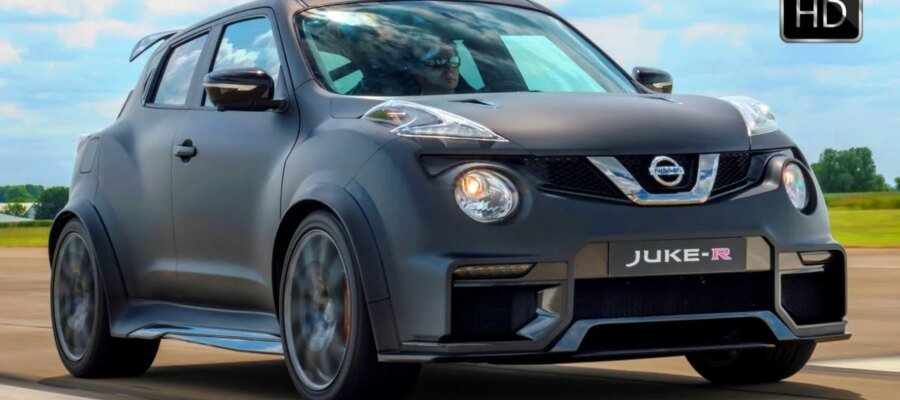
Although this car officially has concept status, it is not just an ordinary vision. If it were otherwise the producers would not have paid so much attention to it, they would not have dragged it from one end of the world to the other and they would not have invited us to test it in Sweden. He is real, drives and can run very fast. Faster than Ferrari or Lamborghini, if we believe the Nissan guys. He is the mutant Juke-R with the crazy appearance and the powerful roar.
It’s hard to believe, but the Juke-R project was born in 2011. in the middle, and less than six months later it was already available for inspection. The premiere did not end without the careful responses of journalists who in some places can stick a finger between the joints of the car parts. However, in the first half of March, at the Sturup circuit in Sweden, we saw a model that looks almost perfect and seems ready for series production.
Nissan Juke-R: a beast trapped in strategies
Back in the early days, when the first rumors came out that Nissan was preparing a Super Juke, I only had one thought in mind: what are they doing? A car with a controversial design clearly attracts more women to our country (look around the streets: there are Jukes everywhere and they are all driven by women), so maybe the Japanese are trying to attract a male audience in this way? Absolutely not! It turns out that, according to available data from Nissan, around 70% of Juke buyers in Europe are men.
If until the end of last year one could still think that Nissan was simply playing with the Juke-R project, the beginning of 2012 has shown that the Japanese are not in the mood for jokes. The Juke-R is faster than the Lamborghini Gallardo, Mercedes SLS AMG and Ferrari 458 Italia supercars, the news arrived in January from Dubai, where the manufacturers had organized a demonstration race on a circuit set up in the streets of the city. And what do they think of themselves? Competing with models for which sports car enthusiasts pay hundreds of thousands of euros doesn’t seem like a logical decision for a company known primarily for making cars for everyday use.
However, given some aspects, the Juke-R project shouldn’t be too surprising. First of all they have the GT-R, which they call their supercar. The philosophy of this model is clear: to offer customers a sports car that is not inferior to Porsche or Ferrari in terms of technical parameters, but costs much less. And that’s it, as visitors to this year’s Geneva Motor Show are left in a frenzy over the new Ferrari Berlinetta F12, which can reach 100 km/h. can accelerate in a “magic” 3.1 seconds, the 2012 Nissan GT-R tackles this task in 2.8 seconds. Prices? The new Ferrari will cost at least 900 thousand. Lieutenant, Nissan highway: about three times cheaper.
The second reason is Nissan’s many years of experience in motorsports. The third explanation for the appearance of the Juke-R is Nissan’s targeted expansion into new segments. Success came to them with the creation of the Qashqai compact SUV, then it was the turn of the Juke, which became the pioneer of B-segment SUVs. Nissan cannot be surprised by the success of this model: last year it accounted for 20%. of all sales of this brand. Since the sale began in September 2010, almost 200,000 people have purchased it. drivers, so love it or hate it, the Juke has become another Nissan bestseller.
The engineers worked correctly
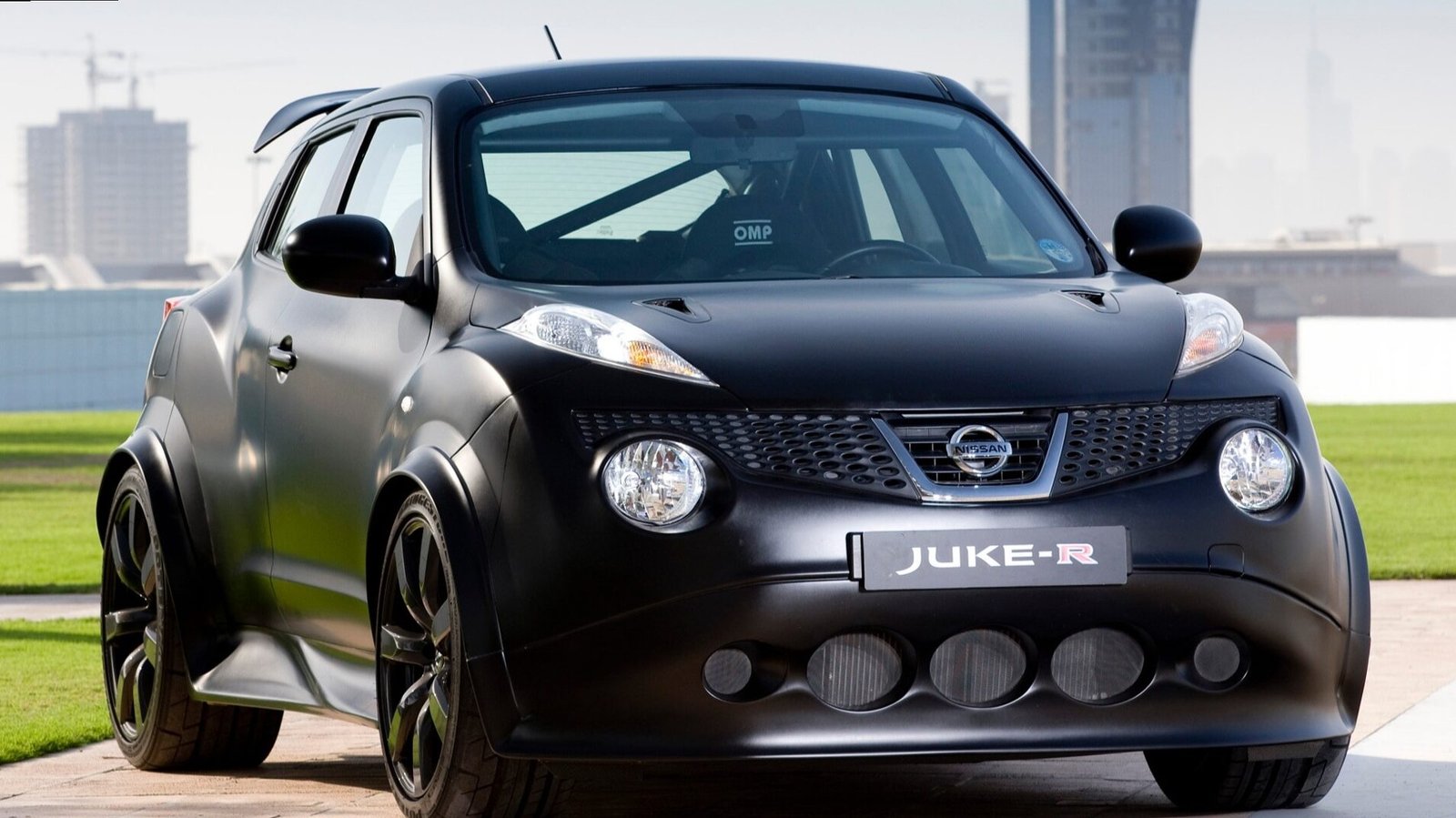
So what is the Nissan Juke-R? Well, the first high-speed supercar that looks crazy and drives like crazy! True, so far only conceptual, but promising. The Juke-R combines bodywork from the regular Juke with units taken from one of the fastest and most technically advanced supercars in the world, the Nissan GT-R. There are currently two hand-assembled prototypes, one with right-hand drive and the other with left-hand drive.
The project originated at Nissan Europe and two examples were built by British-based racing and engineering experts at Ray Mallock Ltd (RML). The latter has accumulated experience in creating models for coachbuilding competitions, Le Mans and other races. RML also implemented the Micra-R “hot hatchback” project a few years ago.
The Juke-R features a 3.8-liter twin-turbo V6 engine paired with a 6-speed automatic transmission. The power unit develops an impressive 485 hp and a maximum torque of 588 Nm. True, under the hood of the sports engine “Juke” the same engine as the GT-R used in the 2010 model year is installed. Now the GT-R has an improved 3.8-liter engine that reaches 550 hp.
The GT-R is 76kg lighter than the Juke-R, thanks to the addition of supercar components to the Juke’s bodywork, including an FIA-approved rollover chassis and extra-strengthened chassis. The exotic-looking model is also embellished with a rear spoiler
The Juke-R’s dimensions suggest it’s more like a regular Juke than a GT-R. The car has the same length, height and chassis length, but the R version is 15cm wider. This change is due to the widened wheel arches surrounding the 20-inch RAYS light alloy wheels.
In the passenger compartment, one of the most obvious innovations are the OMP sports seats, if we don’t count the safety frame and the lack of rear seats. The front seats and the dashboard were moved back by about 10 cm, because the front part of the car had to accommodate a larger engine.
The guys at RML say it was extremely important to them to design the Juke-R to be roadworthy. It also has air conditioning and a sound system. The creators of the car themselves declare that it is such that even grandmothers could go to the store. However, we did not have this opportunity, as we were able to test the Juke-R after a few laps on the Sturup track.
It goes damn fast
You get into the car through the safety structures, fasten your seat belts, press the red “Start” button (the same as the GT-R model), set the automatic transmission lever to position A or M (the latter function allows you to change gear with the “wings” mounted under the steering wheel) and the adventure begins.
How would you describe driving the Juke-R concept? Simply incredible. If you don’t know what hell is, the Juke-R will show you, because to paraphrase the title of the movie “And the Devil Wears Prada”, you can imagine that “And the Devil Drives a Nissan… Juke-R”. The smell of burning tires in the cabin only confirms assumptions that this is a wild car!
The most surprising thing is the power of the 485 hp engine, which seems to snatch the steering wheel from your hands. It seems that a careless step on the accelerator can cause the car to behave unpredictably, but the strict safety systems put everything in place. You entered a corner imprecisely – the ESP will bring you back on track, it seems that you started braking too late – the Brembo tip brakes work at the speed of the driver’s mind and will stop the car even when the test drive seems destined to end in huge losses.
The electronics of the GT-R are unchanged, so the traction of the Juke-R is crazy, with a top speed of 257 km/h. Accelerate up to 100 km/h. means nothing to this bad boy: he can do it in 3.7 seconds. This is a very good result, better than the Porsche 911 and ahead of many recognized supercars.
No matter how many jolts the power of the “Juke-R” caused, on the Sturup track you wanted a longer straight where you could at least push the speed pedal all the way down for a few seconds. On this 2300 m track, even with the theoretically longest straight, you cannot give in to the obsession with speed: as soon as you hear the engine reach maximum speed, you have to brake immediately, until the instructor sitting next to you has time to trumpet “brake, brake, brake”.
Compared to the GT-R, the Juke-R’s wheelbase has been shortened by 250 mm, so the car is agile and maneuverable in corners, but you have to be careful. The weight of the car exceeds 1800 kg and it is definitely not light, so the steering when cornering is insufficient, especially when you carelessly press the speed pedal. And although the steering wheel is not such that the slightest twist can dramatically change the trajectory, but to accuse it of inaccuracy would also be a shame.
The future – in the museum?
Taking a closer look at this unique and unconventional car, it’s clear that Nissan has everything it needs to start production of the Juke-R. It may well be a limited series model, but the company insists that this will not happen, that this monster will not reach series production. So what’s the point of Nissan investing so much effort, time and, of course, mud if the Juke-R is going to the museum anyway?
The answer could be the same one you get when you ask why the Ministry of Culture had to allocate 2 million. Fancy a Tad Blind movie? The point is, people need heroes. If we looked at it only from the point of view of rationality, those millions could have been spent for nobler purposes or distributed to more projects. However, this investment paid off, our “world equalizer” allowed viewers who saw the film to see the beauty of Lithuania with different eyes, emigrants to fall in love with their homeland again, and filmmakers can now be proud of having made the most profitable Lithuanian film. Yes, Nissan could have gone the easy route, burying the super Juke fantasy deep inside, but it took a risk and now the Juke-R is today’s Nissan hero, the subject of everyone’s chatter.
Even if the Juke-R will never hit the streets, Nissan has already made enough money from this project. Internet portals are abuzz with reports, photos and videos of the Juke-R, car enthusiasts passionately discuss the project and the name Juke is everywhere.
And here it was announced last week at the Geneva Motor Show that we will have a sporty Juke. But we have to disappoint, it won’t be the R version, but the Nismo. This model will appear later this year, but will have to be limited to much more modest power than the concept R version: the Juke Nismo will have a 1.6-liter turbocharged engine with 200 hp. Meanwhile, the beastly “Juke-R” will serve the company at various events this year, and what will be the future of this beast imprisoned in Nissan’s strategies – no one knows yet.
Nissan Juke-R business card
Engine capacity: 3.8L
Fuel: petrol
Gaul: 485 AD
Maximum torque: 588 Nm
Gearbox: 6-speed automatic
Drive wheels: 4×4
Ilgis: 4135 mm
Width: 1910 mm
Height: 1575 mm
Frame base: 2530 mm
Ground clearance: 115 mm
Weight: 1806 kilograms
Acceleration to 100 km/h: 3.7 seconds.
Maximum speed: 257 km/h.
latest posts published
Citroën ë-Jumpy won the prestigious Millésime Trophy
The purpose and function of the stabilizer
Maintenance of vehicles (transporting dangerous goods)
The Lithuanian jubilee elections for “Car of the Year” have begun
Volkswagen presented the updated T-Roc
An intelligent wildlife warning system for motorists
Features of electric car charging with a simple click
Four ways to identify a sunken car
In the new city – 2 kilometers of new cycle paths, pedestrian paths are being renovated