
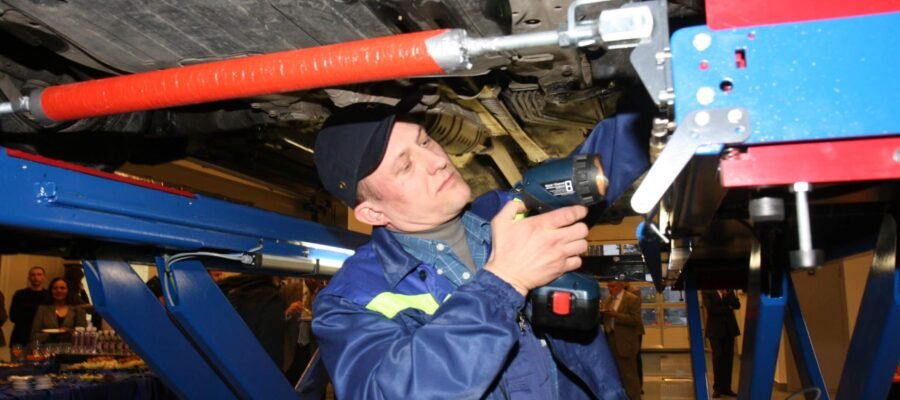
To address this, a specific assessment standard has been established: prohibition from driving. This means that vehicles that do not meet installation and technical specifications pose a direct risk to road safety, personal health, and the environment. This standard is more stringent than a “serious defect” assessment, which allows continued operation within the validity period of a Periodic Technical Inspection (PTI). However, the PTI can only be extended after the defect is rectified.
It is important to note that inspectors will determine the category of a specific defect based on established standards.
Human factors can also have an impact. Therefore, it should not be surprising if a fault identified as a serious defect in the previous inspection does not result in a PTI extension for the next inspection. To avoid this, we have listed all the standards for assessing the technical condition of a vehicle; if these standards are not met, the vehicle will be prohibited from use.
There are no minor defects in the suspension

Normally, very worn joints are classified as serious defects, but due to their enormous impact on road safety, they can also be classified as extreme. Defects in the drawbars are also rigorously evaluated: if they are cracked, deformed or connected unreliably, the vehicle will be considered unsafe.
When inspecting the front and rear suspension, check for cracked, deformed, or displaced parts in the steering system and between the spring elements. The front and rear axle beams, arms and struts shall not be seriously damaged by corrosion, nor may they be straightened, welded or otherwise mechanically repaired, if this leads to a change in strength and other properties or a violation of the functional purpose.
It is forbidden to use vehicles on which the power steering is not correctly fixed. Additionally, the steering system must be installed to meet the manufacturer’s requirements. It is useless to take cars for technical inspection with the steering wheel on the right side of the bodywork. The exception applies only to vehicles registered in Lithuania before May 1, 1993 and to special transports. The controllers also check the handlebar mounts of motorcycles and mopeds. If it’s not reliable, you won’t be able to drive anywhere.
The biggest problems concern the brakes
The maximum number of criteria that can result in a vehicle being banned from circulation can be found in the description of the braking system. Insufficient braking force can be considered a dangerous defect for other road users, regardless of the axle to be controlled. Leaking brake fluid from the main or single wheel caliper cylinders is also no small problem – this shortage can lead to the car being left in the parking lot of the technical inspection center.
Brake system hoses or hoses must be maintained and sealed. Operation is prohibited if significant corrosion or mechanical damage is detected. Particular attention should be paid to the connections: there can be no leaks. The same applies to brake chambers and energy accumulators.
Vehicles with cracked or deformed brake discs or drums cannot be driven on public roads.
Improving the brake system must be carried out carefully, since the use of unexpected parts or assemblies is prohibited. Additionally, all parts and assemblies must be securely fastened.
Even for heavy machinery it is necessary that it is not possible to register major air leaks from the pneumatic braking system.
The robustness of the structure is evaluated
One area that drivers are a little more familiar with is tires. Most people know that the MOT can be canceled for serious breaches. Passenger cars cannot use summer tires from November 10th to April 1st and studded tires from April 10th to November 1st. It should be borne in mind that damage to the rims is also considered a critical defect during the technical inspection.
The parts of the chassis and the load-bearing structure of the bodywork must not present any obvious cracks, breaks or deformations.
The movement of vehicles is prohibited if the supporting structure is weakened due to corrosion, as well as when connections are not tightened, not tight or welds are cracked. However, in this case, the controller does not have special devices or more precise quantitative parameters, and the control is carried out by inspection.
Among the technical requirements there is an extremely interesting point that specifies the driving ban. It says fuel leaks are assessed extremely rigorously, so such vehicles cannot be driven on public roads.
If at least one defect is found in the car, according to which it is forbidden to use the vehicle, the conclusions underline that it will be possible to return to circulation only after having removed the defect and passed the TA again, and the car will have to be taken away from the TA center with a tow truck. It is true that only a limited number of drivers meet this requirement. TA controllers are not considered officers, so they cannot stop a person if he tries to drive away alone with a disheveled car and issue a fine. Therefore, many drivers take the risk of driving and hoping not to be seen by officers.
latest posts published
Citroën ë-Jumpy won the prestigious Millésime Trophy

The purpose and function of the stabilizer

Maintenance of vehicles (transporting dangerous goods)
The Lithuanian jubilee elections for “Car of the Year” have begun

Volkswagen presented the updated T-Roc

An intelligent wildlife warning system for motorists

Features of electric car charging with a simple click
Four ways to identify a sunken car
In the new city – 2 kilometers of new cycle paths, pedestrian paths are being renovated