
Effective industrial cleaning of stainless steel requires identifying the specific grade (304 or 316) before selecting the appropriate cleaners. For oily residues use alkaline detergents with non-abrasive cloths, working with grain. For mineral deposits use acid-based solutions. Always wear appropriate PPE and ensure adequate ventilation when using chemicals. Implement daily cleaning routines to prevent buildup and extend the life of your equipment. The right maintenance strategy will protect your investment while maintaining critical surface integrity.
Main results
- Clean stainless steel with alkaline cleaners for oily residues and acid-based solutions for mineral deposits, working with the grain.
- Identify the specific grade (304 or 316) before cleaning, as each requires tailored approaches to maintain its integrity.
- Use non-abrasive tools designed specifically for stainless steel to avoid scratches and surface damage.
- Implement regular preventative maintenance with daily cleaning schedules to prevent contaminant buildup.
- Apply protective coatings after cleaning to create barriers against future industrial contaminants and extend the life of your equipment.
Understand the different grades of industrial stainless steel
During selection cleaning protocols suitable for industrial environments, it will be necessary to first identify the specific degree of stainless steel who you work with. The two most common grades: 304 stainless steel and 316 stainless steel—have distinct properties of stainless steel that directly affect the maintenance requirements.
304 stainless steel offers excellent corrosion resistance, making it suitable for food processing equipment. However, its relatively soft surface necessitates scratch-resistant treatment. Furthermore, its numerous advantages make it ideal for a variety of hygienic applications.
In contrast, 316 stainless steel contains molybdenum, providing better resistance to chlorides commonly found in marine or chemical environments.
This comparison of the two stainless steels demonstrates that while both are stain-resistant, their different compositions require specific cleaning methods.
316 stainless steel maintains its performance even with the strongest cleaning agents, while 304 stainless steel may require milder cleaning agents to maintain its properties.
Regular maintenance based on specific quality characteristics can significantly extend the lifespan of equipment.
Essential cleaning products and solutions for heavy-duty applications
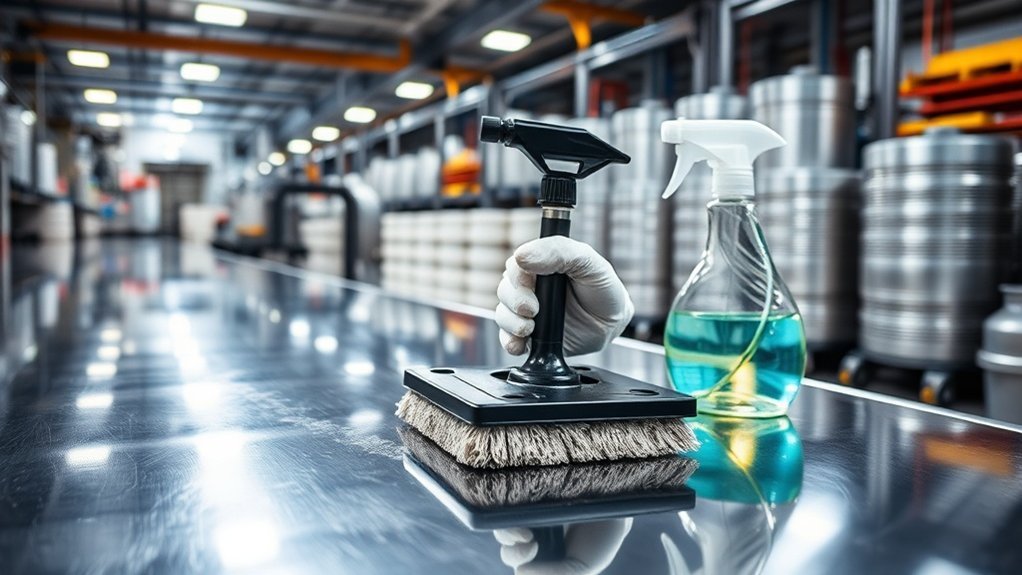
Select the right ones cleaning products for applications in industrial stainless steel requires particular attention to both the type of contaminant and the specific grade to be maintained.
For the stubborn fats and calcium deposits, alkaline and acid based stainless steel cleaners provide superior results in harsh environments.
You will find the ecological detergents equipped with the Ecolabel certification which is particularly valuable in food processing areas, where the environmental impact must be reduced to a minimum without compromising the effectiveness of cleaning.
For applications that require disinfectionprofessional industrial disinfectants not only clean surfaces but also eliminate pathogens, ensuring compliance with rigorous hygiene standards.
After cleaning, apply specialized protectors for stainless steel to create a barrier against future contamination. This practice extends the life of the equipment while maintaining its aesthetic appearance.
Regular maintenance with quality products prevents the buildup of contaminants, preserving both the functionality and appearance of your industrial stainless steel installations. Furthermore, the use of effective cleaning techniques can significantly improve cleanliness and safety in professional environments.
Appropriate techniques for the removal of contaminants and industrial residues
Identify yours type of contaminant before starting any industrial stainless steel cleaning procedure. For the oily residue and grease, apply alkaline detergents with a non-abrasive cloth, working with the grain of the steel so as not to damage the surface.
Acid-based solutions are more effective against mineral deposits and limescale buildup.
When implementing cleaning methods for industrial contaminants, always wear a protective devices appropriate and ensure adequate ventilation. In areas with hard water, incorporate regular descaling into your maintenance schedule to prevent scale build-up.
Apply the cleaner, wait for the appropriate contact time according to the manufacturer’s instructions, then rinse thoroughly.
Choose ecological detergents where possible, they are safer for workers and effectively remove industrial contaminants. The best products for maintaining stainless steel can improve the cleaning process and ensure optimal results.
Remember that regular and correct cleaning maintains the durability of the equipment and prevents cross-contamination in your industrial environment.
Preventive maintenance strategies to extend the life of your equipment
Preventive maintenance is the cornerstone to extending the lifespan of stainless steel equipment in industrial environments.
You will maximize the longevity of the equipment by implementing it daily cleaning programs which prevent the accumulation of grease and hard water deposits. These contaminants can compromise the integrity of the surface if left untreated.
Run preventive inspections regularly to identify the first signs of wear or corrosion. This proactive approach allows for rapid intervention before minor problems become costly.
Incorporate special detergents in your maintenance programs: alkaline products for degreasing and acid-based formulations to descale stubborn residues.
Apply to protective coatings specially designed for stainless steel to create effective barriers against industrial contaminants.
Don’t forget the adequate training : Make sure your staff cleans with grit to avoid microscopic scratches that can harbor bacteria and accelerate deterioration.
Safety protocols when cleaning stainless steel in manufacturing environments
Four essential safety protocols should be implemented when cleaning stainless steel in industrial environments.
First of all, always wear it EPI equipment, including gloves and eye protection, to protect you from chemical hazards and splashes.
Secondly, strictly follow the lock-out/de-lockout procedures before starting any cleaning activity to prevent the machines from turning on unexpectedly during maintenance.
Third, make sure adequate ventilation in the work area, especially when using chemical cleaners, to minimize the risk of inhalation.
Fourth, check the Material safety data sheets that all products include handling instructions and emergency response measures.
Also, use only non-abrasive tools specifically designed for stainless steel to maintain the integrity of the equipment.
A safety training Regular training should emphasize these protocols, teaching workers to recognize potential hazards and respond appropriately to incidents involving chemicals or cleaning equipment.
latest posts published

Citroën ë-Jumpy won the prestigious Millésime Trophy

The purpose and function of the stabilizer

Maintenance of vehicles (transporting dangerous goods)

The Lithuanian jubilee elections for “Car of the Year” have begun

Volkswagen presented the updated T-Roc

An intelligent wildlife warning system for motorists

Features of electric car charging with a simple click
Four ways to identify a sunken car

In the new city – 2 kilometers of new cycle paths, pedestrian paths are being renovated