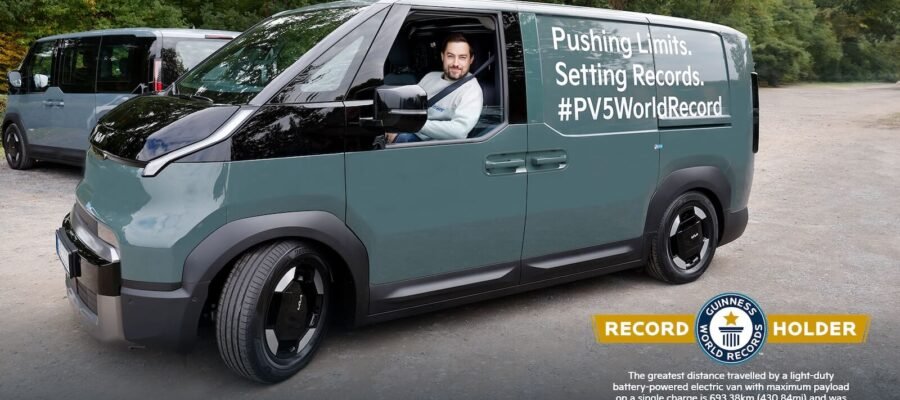
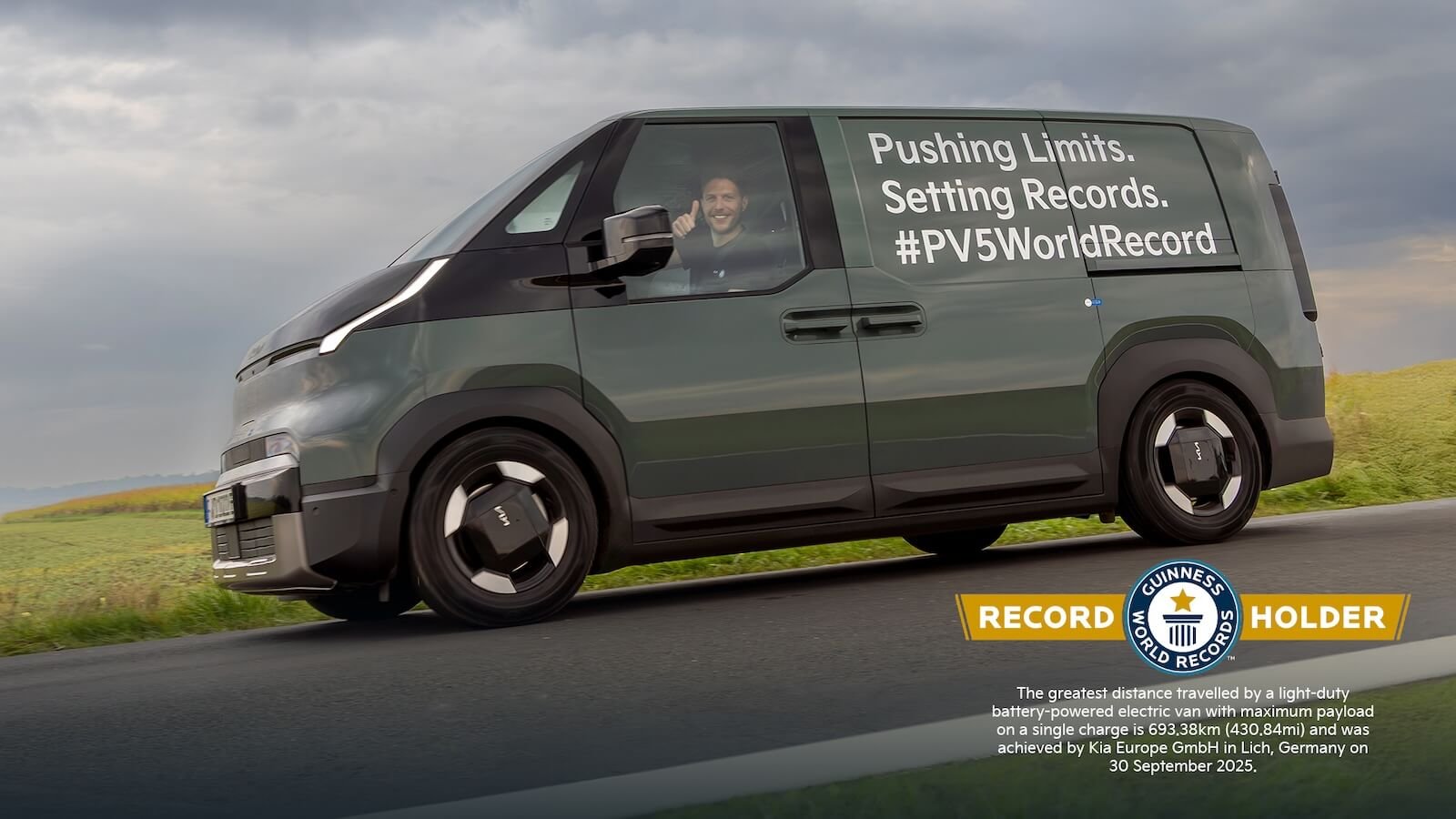
“Although Kia is new to the light commercial vehicle market, this record is testament to the versatility and innovation behind our first PBV model and demonstrates that we are serious players.” The fact that most of the companies this van caters to can do almost two full days of work on a single charge says a lot about its true capabilities. The PV5 combines efficiency, flexibility and intelligent connectivity in one product,” noted Marc Hedrich, President and CEO of Kia Europe.
Proven everyday practicality
The record-breaking route was carefully planned to replicate the daily reality of delivery and logistics activities. Traveling along a 58.2 kilometer ring of city-country roads, the PV5 Cargo encountered traffic lights, intersections, roundabouts and typical city traffic, fully in line with the conditions that many drivers in the logistics sector face on a daily basis.
Furthermore, the van had to overcome a height difference of approximately 370 meters each time, making the same lap 12 times, always carrying the maximum load, and finally stopped at the end of the twelfth lap. These difficult conditions allowed the authors of the record to ascertain the efficiency and reliability of the PV5 Cargo.
Record heroes behind the wheel
George Barrow, a respected commercial vehicle journalist specializing in vans, and Christopher Nigemeier, a senior engineer at Hyundai Motor Europe Technical Center (HMETC), sat behind the wheel of the record-breaking electric vehicle.
The award-winning journalist has been writing about light commercial vehicles for over 15 years. Since 2016 he has also been a member of the International Van of the Year (IVOTY) jury, representing the United Kingdom. Meanwhile, chap. Nigemeier, who earned his bachelor’s degree in mechanical engineering, was a member of the PV5 development team.
“I’m really happy to be part of this incredible Guinness World Record: it was a challenging but memorable journey. I’m really impressed with the range the Kia PV5 can travel: over 430 miles on a single charge and fully loaded.” This is an impressive achievement and I think it will be very difficult to beat this record. PV5 and Christopher have been great teammates in this challenge and I am proud to be part of this cutting-edge story of electric vans,” said Barrow.
“As an engineer, this challenge for me was both technical and personal. George brought with him extensive driving experience gained from testing other vans, and I had the advantage of knowing the PV5 powertrain very well. There was a friendly competition between us to see who could make the most of every kilowatt hour. In the end, we were both very surprised by the car itself,” admitted Ch. Nigemeier.
The record-breaking run was methodically planned and executed with extreme care. The cargo loading process was supervised by inspectors from TÜV Hessen and Buck Vermessung, who confirmed that the car met the weight specifications. The journey was constantly monitored by GPS tracking equipment and cabin cameras. The PV5’s battery was charged to 100% before departure and the charging port and cargo compartment were sealed for the duration of the 22 hour 30 minute journey.
The first member of the Kia PBV family
The first model in Kia’s PBV family, the PV5 is built on the innovative E-GMP.S (Electric-Global Modular Platform for Service) architecture and designed according to the modular concept of “selectable parts”. This flexibility allows the car to be adapted to various versions: cargo, passenger, short cabin with open transport box or transport adapted for disabled people. All options meet different business and personal needs.
The PV5 Cargo version offers up to 4.4 cubic meters of cargo space (in the L2H1 configuration (the L2H2 version, which will be introduced next year, will offer even more capacity) and a payload of up to 790 kilograms. Buyers will be able to choose between different battery versions – 51.5 kWh, 71.2 kWh and the new 43.3 kWh – which will be adapted to different operational needs.
latest posts published
Citroën ë-Jumpy won the prestigious Millésime Trophy

The purpose and function of the stabilizer

Maintenance of vehicles (transporting dangerous goods)
The Lithuanian jubilee elections for “Car of the Year” have begun
Volkswagen presented the updated T-Roc

An intelligent wildlife warning system for motorists
Features of electric car charging with a simple click

Four ways to identify a sunken car
In the new city – 2 kilometers of new cycle paths, pedestrian paths are being renovated