Although advanced electrical systems in cars and ever-improving charging infrastructure are significantly reducing the charging times of electric cars, it still takes longer to recharge the battery than the fuel tank. And if your destination is further from the main roads, you won’t necessarily find the fastest stops there. As a result, EV buyers still pay close attention to range per charge.
It would seem that increasing it is not difficult – you just need larger batteries. However, this will not necessarily be effective, as the cycle of inconveniences is reversed. Large batteries make the electric car much more expensive, but they also make it heavier, which reduces its performance and therefore its range. Furthermore, the charging time increases even more.
However, in the long term, optimal battery sizes have already been established in the electric car market. Here the compact city cars are satisfied with batteries with a capacity of up to 50 kWh, which allow you to travel about 300 km in real conditions, the mid-range models have 70-80 kWh batteries that can travel 400-500 km. Large, heavy and powerful representatives of the “premium” segment are usually equipped with batteries of about 100 kWh, which allow you to overcome the same 400-500 km.
What is the effect of aerodynamics?
And how to extend the driving range without increasing the batteries? Improve the efficiency of the entire system. Therefore, manufacturers are actively playing with the aerodynamics of electric cars. Some abandon conventional mirrors and install digital ones, others install automatically closing vents, others try to create the most elegant shapes possible, etc.
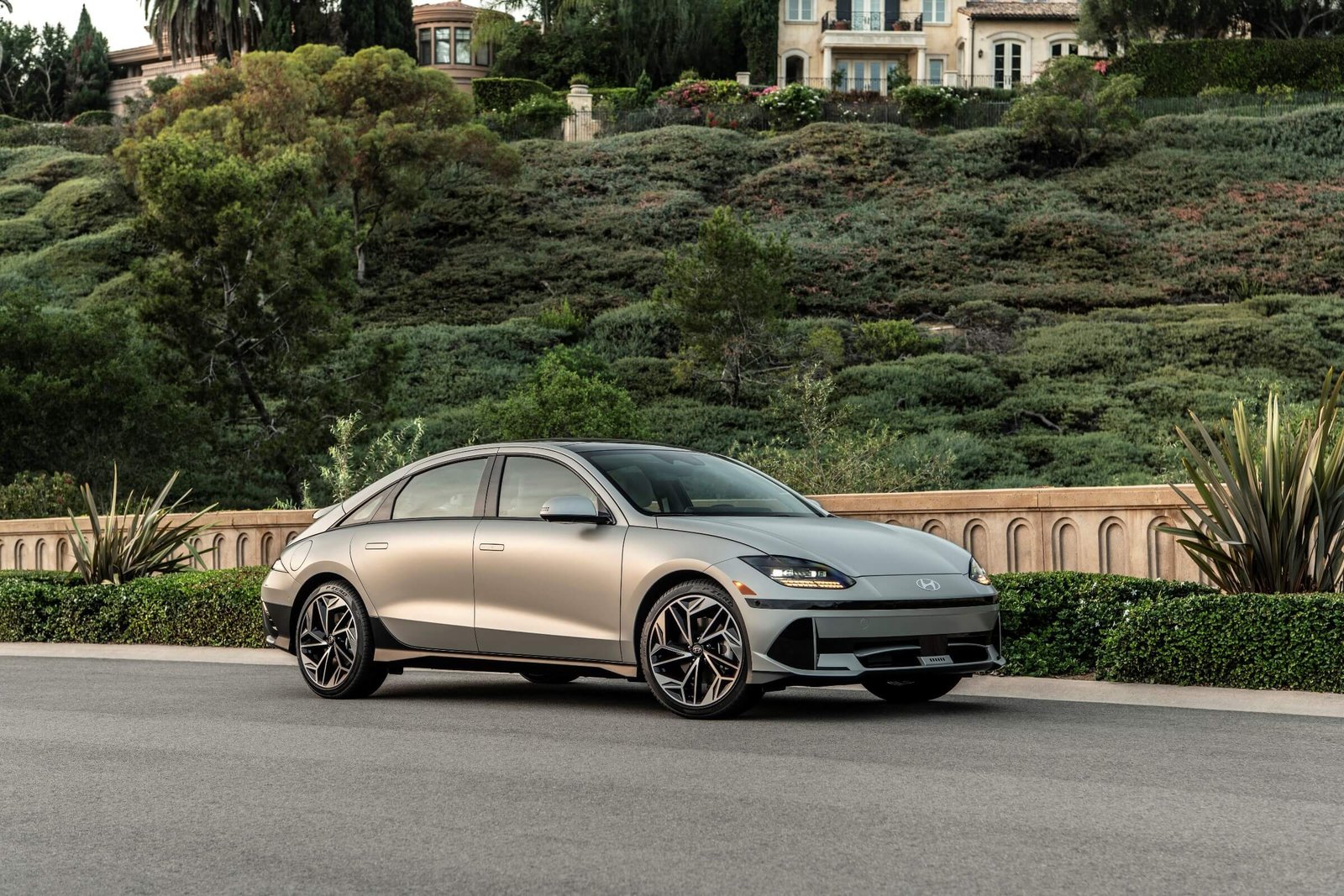
Here, Hyundai recently presented an innovation: active airfoil (otherwise known as air skirt) technology that reduces turbulence under the car at high speed and thus improves aerodynamic drag. The impact of aerodynamics on the range of electric cars can be seen by comparing two Hyundai models: Ioniq 5 and Ioniq 6.
These electric cars share the same platform, the same electric motors and have the same batteries with a usable capacity of 74 kWh. Only one is a stylish, but tall and angular crossover, and the other is a low and long sedan.
The single-engine, rear-wheel drive crossover Ioniq 5 can travel 507 km on a single charge according to the WLTP methodology, and 614 km for the sedan. The difference is more than 100 km, even if electric cars differ only in the bodywork. The Ioniq 5 has a drag coefficient of 0.288 Cd, while the Ioniq 6 has a drag coefficient of just 0.21 Cd. It is one of the most aerodynamic cars on the market.
“The biggest sword for electric cars is high speed on the highway. Electric cars don’t have a gearbox, because theoretically they don’t need one: maximum torque and maximum power are available throughout the entire rev range, no matter how fast you go. But at high speed, the engine spins much harder, so it receives more load.”
Furthermore, as speed increases, air resistance increases sharply. So it’s natural that more power is needed to maintain higher speeds and performance suffers as a result. Good aerodynamics allows you to reduce air resistance and overcome an invisible obstacle more efficiently,” explains the regulations of the Hyundai Ioniq 6 “Ignitis ON: Get to know Lithuania!” journalist Egidijus Babelis, winner of the electric car race in 2023.
Crossovers can also be aerodynamic
Now manufacturers are introducing one after another more rounded, lower and long-range electric sedans and station wagons: Volkswagen ID.7 debuted on the market, Mercedes has EQS and EQE, BMW has i5, Tesla sedans are also characterized by good aerodynamics. However, most buyers don’t want them at all. The most fashionable now are SUVs and crossovers. In addition, their tall bodies create a lot of air resistance, so manufacturers try to improve the aerodynamic properties with clever solutions.
“Aerodynamics is in the small details, so even a boxy design can be quite elegant. New cars have a number of things that we don’t notice that improve aerodynamics. For example, bumpers direct the airflow so that it doesn’t enter the wheel arches.
There is a lot of potential in the bottom of the car, even the wheel arches make a difference. Today’s modern “tanks” may be more aerodynamically efficient than the low-slung and seemingly rather elegant cars produced twenty years ago,” says transportation designer Dominykas Budinas.
In fact, no matter how aerodynamic the body is, the greatest detriment to performance can be the bottom of the car, where various structural features create turbulence. Electric cars built on dedicated platforms have an advantage: their bottom can be completely flat. But another problem is the wheels. They create a lot of resistance and it is impossible to cover the main element in contact with the road.
Therefore, Hyundai, having created a completely flat E-GMP platform, also found a solution to the above-mentioned problem. Active Air Skirt (ASS) technology reduces air resistance at high speeds.
When the car exceeds 80 km/h, additional deflectors in the front bumper in front of the wheels descend almost to the ground, directing the air flow from the wheels outwards, so as not to create turbulence in the lower part. The system is also effective above 200 km/h. limit.
More solutions
Thanks to improved aerodynamics, manufacturers are starting to install more solutions in cars. For example, digital mirrors, where a small camera creates significantly less resistance than “elephant ears”.
Digital mirrors can reduce drag by 2 to 7 percent, depending on speed and shape. They were the first to be massively used by the Germans in the Audi E-Tron model, such mirrors can also be found in Hyundai Ioniq 6 or Honda E cars.
Another technological trick often used by manufacturers is to close the air intake holes when cooling is not needed. Because all the unnecessary details and holes in the car create more air resistance.
latest posts published
Citroën ë-Jumpy won the prestigious Millésime Trophy

The purpose and function of the stabilizer

Maintenance of vehicles (transporting dangerous goods)
The Lithuanian jubilee elections for “Car of the Year” have begun
Volkswagen presented the updated T-Roc
An intelligent wildlife warning system for motorists
Features of electric car charging with a simple click
Four ways to identify a sunken car
In the new city – 2 kilometers of new cycle paths, pedestrian paths are being renovated