


What Is the MGU-K in a 2026 F1 Car? Energy Flow Explained
September 27, 2026 | by EngineGeek Editorial
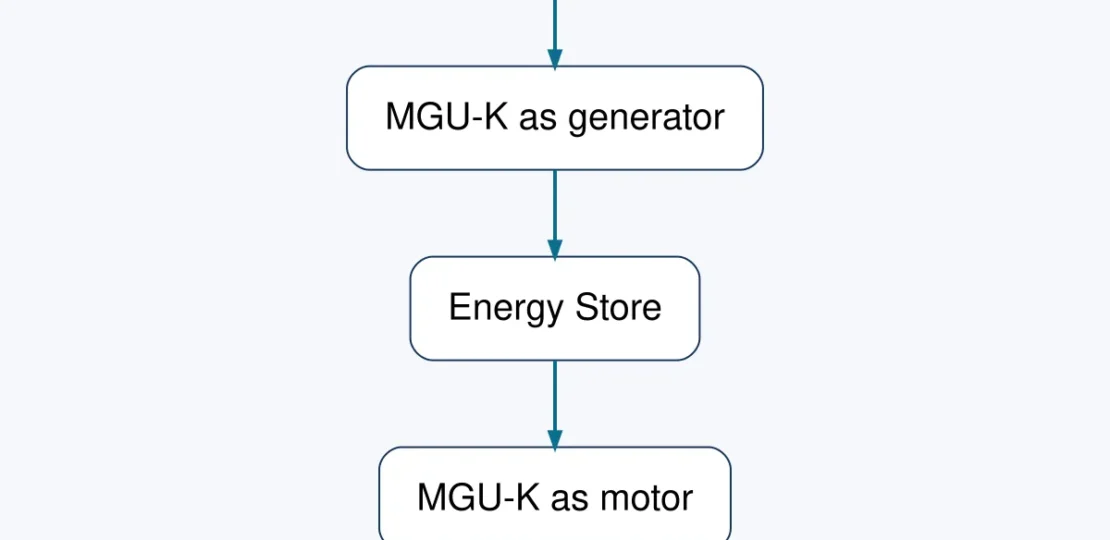
What does the MGU-K actually do in a 2026 Formula 1 car? It is the electric motor-generator connected to the power unit’s drivetrain. In one direction, it resists rotation and turns some of the car’s mechanical energy into electricity for the energy store. In the other, it draws electricity from that store and adds torque to help drive the car. The two directions explain why energy management matters so much in 2026.
The letters stand for Motor Generator Unit – Kinetic. “Kinetic” distinguishes it from the former MGU-H, which recovered energy associated with the turbocharger and is absent from the 2026 power-unit concept. A motor and a generator are not separate gadgets here: the same electrical machine can operate in either mode. The drawing below is a conceptual energy-flow map, not a mechanical drawing or team telemetry.
EngineGeek original diagram · Direction of energy flow only; losses and mechanical layout omitted.
How does the MGU-K recover energy?
During braking, the car has kinetic energy that the driver wants to remove before a corner. Instead of asking the friction brakes to dissipate all of it as heat, the MGU-K can apply a resisting torque through the drivetrain. Operating as a generator, it converts part of that mechanical input to electrical energy. Power electronics manage the electricity sent to the energy store. The friction brakes still matter: the rear brake system must provide a predictable response as electrical recovery changes.
Recovery is not limited to brake-pedal use. Formula 1 also describes charging while the driver lifts, uses part throttle, or remains at full throttle in a strategy commonly called super clipping. The distinction is the driving condition, not a different battery. At full throttle, using the MGU-K as a generator diverts some mechanical power that could otherwise help propel the car. Our illustrated super-clipping guide explores why a team might accept that short-term loss for a later gain.
What happens when it deploys energy?
The electrical flow reverses. The energy store supplies electricity through the control electronics to the MGU-K, which now acts as a motor. Its torque helps turn the drivetrain and adds to the combustion engine’s contribution. That can be particularly valuable out of a corner or in a permitted overtaking situation. It is inaccurate to describe the battery as delivering the same assistance everywhere: energy availability, speed-dependent limits, operating modes and current rules all matter.
A useful distinction is power versus energy. Power, measured in kilowatts (kW), describes the rate at which energy is delivered or recovered at an instant. Energy, measured here in megajoules (MJ), describes the quantity available over time. As a simple idealized calculation, 350 kW held for one second equals 0.35 MJ. This is arithmetic, not a claim that an F1 car maintains 350 kW for any particular second, lap or circuit.
Is the 2026 MGU-K always a 350 kW motor?
No. The 350 kW figure describes the peak capability cited for the 2026 generation, compared with 120 kW in the preceding era; it does not mean constant delivery. The FIA announced in April 2026 that deployment would remain at 350 kW in designated key acceleration areas but be limited to 250 kW in other parts of the lap. It also announced a separate cap on the extra power available through the race Boost function. Those numbers refer to different conditions and must not be added together as if they were independent motors. For the driver controls behind those numbers, read Boost vs Overtake Mode.
The same FIA announcement changed permitted qualifying recharge parameters and increased peak super-clipping recovery power to 350 kW, with application in races too. A larger peak recovery rate does not mean unlimited energy can be harvested over a lap: rate and total amount are different constraints. Circuit-specific energy limits and later revisions can change the detailed picture, so always check the event’s current rules when interpreting telemetry or broadcast graphics.
Why did the MGU-K become more important in 2026?
The 2026 rules place a much larger share of the power-unit concept on electrical energy, while removing the MGU-H. Mercedes’ technical overview compares the MGU-K’s 120 kW in the earlier generation with 350 kW in the 2026 design. Because that electrical contribution must be replenished, the point on the lap where a team harvests or deploys energy becomes a trade-off: giving up some speed now may enable more useful acceleration later. The quickest strategy depends on the circuit and the car; there is no universal battery map.
This also changes how viewers should interpret a car slowing near the end of a straight. It might be harvesting at full throttle, reducing deployment, encountering aerodynamic drag, or responding to another factor. A speed trace alone does not reveal the team’s chosen mode. See our active aero versus DRS guide for the separate wing and overtaking systems; wing position and electrical deployment should not be conflated.
A three-step way to read the energy flow
1. Ask where the mechanical energy goes. Under harvesting, resisting torque at the driven axle can be converted to electrical energy, with losses along the way. 2. Ask where the electricity goes. The energy store holds it for later use within the applicable limits. 3. Ask when it returns. In motor mode the MGU-K adds torque through the drivetrain. The diagram shows directions, not the size of the flow; the engine, friction brakes, control electronics and aerodynamic forces remain part of the full car.
Sources, limitations and update note
Primary references: the FIA’s 20 April 2026 rule-refinement announcement, Mercedes-AMG F1’s technical power-unit overview, and Formula 1’s 2026 rules explainer. The energy-flow figure and the power-versus-energy calculation are EngineGeek’s original explanatory work. This is an educational model, not an engineering specification or access to a team’s calibration. Reviewed September 2026; check the FIA regulation index for subsequent changes.
RELATED POSTS
View all

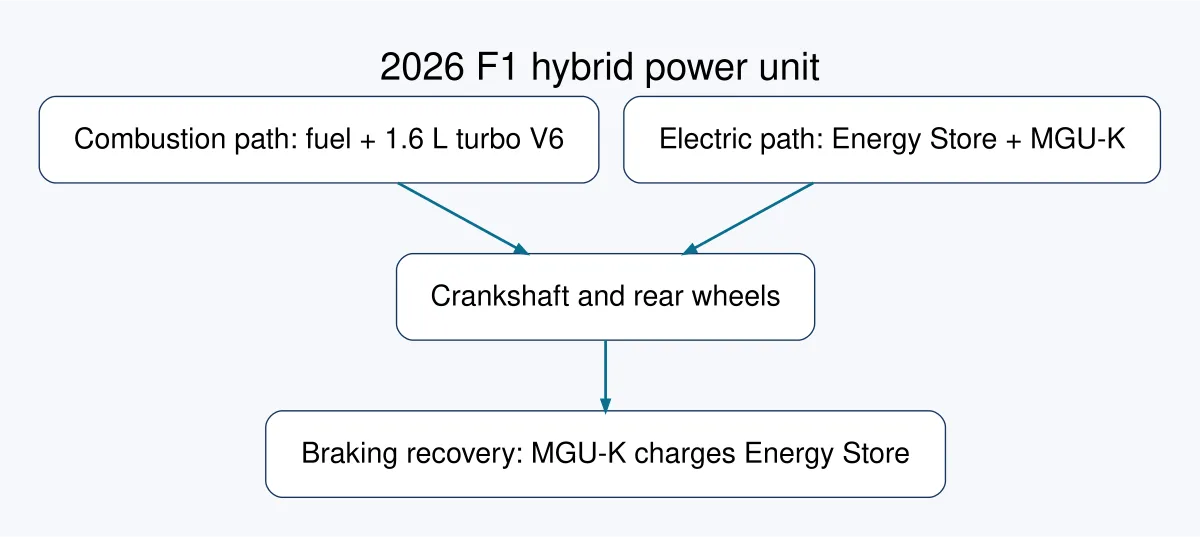
2026 F1 Hybrid Engine Explained: V6, MGU-K, Battery and Energy Flow
October 2, 2026 | by EngineGeek Editorial
F1 Boost vs Overtake Mode in 2026: Power, Energy and the One-Second Rule
September 27, 2026 | by EngineGeek Editorial
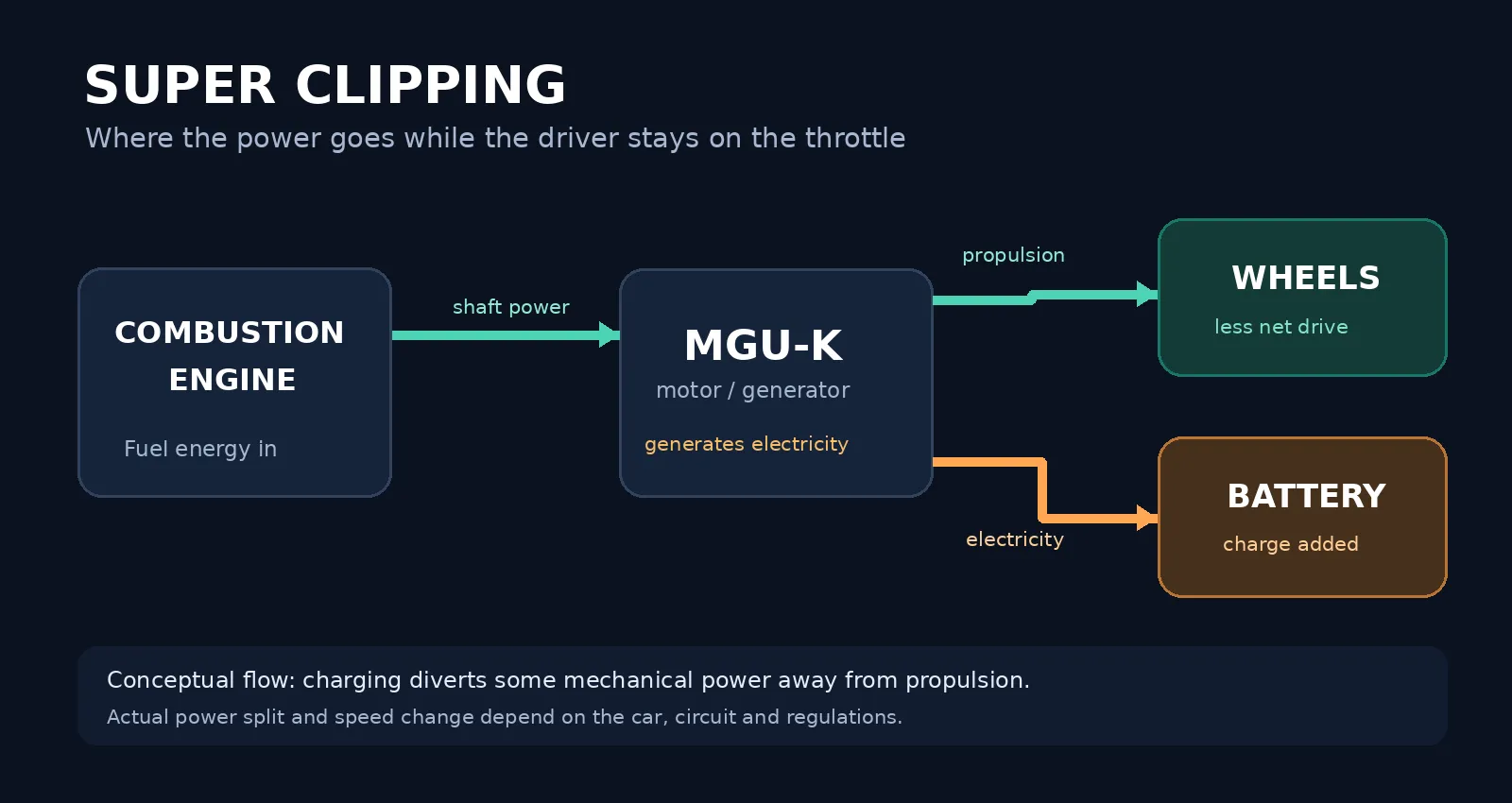
F1 Super Clipping Explained: Why Cars Recharge at Full Throttle
September 25, 2026 | by EngineGeek Editorial