


F1 Boost vs Overtake Mode in 2026: Power, Energy and the One-Second Rule
September 27, 2026 | by EngineGeek Editorial
Short answer: Boost is a driver-operated way to call on available power. Overtake Mode is an eligibility-based electrical advantage for a car that was within one second of another at the designated detection point. They are not two names for the same button. Neither changes the wing position: that is the separate active-aero system.
The 2026 terminology sounds deceptively simple until the numbers appear. A broadcast may mention 350 kW, an extra 0.5 MJ, or the race Boost cap of +150 kW. Those describe different things: a power limit, an energy allowance and a temporary power condition. Understanding the units makes a race much easier to follow.
The one-minute comparison
| Question | Boost | Overtake Mode | Straight Mode |
|---|---|---|---|
| What changes? | Power-unit output requested by the driver. | A following car gains an additional electrical power profile and recharge allowance. | Front and rear wing configuration, reducing drag in permitted zones. |
| Who can use it? | A driver with charge available, within applicable rules and settings. | A driver within one second at the designated detection point, for the following lap. | Drivers in designated active-aero zones, regardless of proximity to another car. |
| What is the key constraint? | Battery state, power-unit settings and current race limits. | Proximity check, extra energy allowance and available charge. | Circuit zone and activation/safety conditions. |
| Is it a wing device? | No. | No. | Yes. |
What does the Boost button do?
Formula 1 describes Boost as a driver-operated energy-deployment tool. It can help attack a car in front or defend from one behind. Pressing it changes the power-unit setting, returning toward maximum power or a team-configured profile, provided that sufficient energy is available. The button does not conjure a fresh battery charge and it does not require the driver to be within one second of another car. The precise effect depends on the car’s current deployment, energy state and rules in force.
The FIA’s 20 April 2026 refinement, later described by the FIA as introduced at Miami, describes the maximum power available through Boost in race conditions as capped at +150 kW, or the car’s current power level at activation if that is higher. That wording matters. It is not a promise of a 150 kW gain at the wheels each time a driver presses a button. The FIA also retained MGU-K deployment of 350 kW in key acceleration zones while limiting it to 250 kW in other parts of the race lap. Those limits govern the system’s operation in context.
What qualifies a driver for Overtake Mode?
Overtake Mode is a different tool: a following driver must be within one second of the car ahead at the designated detection point. Formula 1 says the resulting mode can be used on the following lap. Qualifying for it does not automatically complete the pass or give unlimited battery power. The driver still has to choose when the extra electrical capability will be most useful. The exact detection location and applicable parameters belong to the event instructions.
The mode provides an additional electrical power profile, intended to help sustain speed rather than merely deliver a momentary peak. Formula 1 also describes an extra 0.5 MJ recharge allowance. “Allowance” is the careful word: the car must recover and store energy within the applicable limits before that energy can be deployed. There is no separate Overtake battery hidden in the car.
Why are 0.5 MJ and 150 kW not comparable speeds?
A kilowatt measures a rate of energy transfer: power. A megajoule measures an amount of energy. In unit terms, 1 kW is 1 kilojoule per second, and 0.5 MJ equals 500 kilojoules. Those relationships do not specify how a particular F1 car distributes power during a lap. You would need a chosen power profile, duration and losses to translate an energy budget into a useful speed prediction.
The +0.5 MJ associated with Overtake Mode is an extra recharge allowance described by Formula 1. The +150 kW in the FIA refinement is the race Boost condition stated above. The 350 kW is a ceiling relevant to MGU-K deployment in specified acceleration sections, not a constant car-wide output. Treating the three figures as competing “horsepower boosts” loses their meaning.
A visual decision map
| Situation | Driver/system action | What to expect |
|---|---|---|
| Alone on a permitted straight | Use Straight Mode if the zone and conditions allow. | Wings move to a lower-drag setting; no one-second check. |
| Needs a burst for attack or defense | Use Boost if charge and settings permit. | A driver-requested power-unit response within race limits. |
| Within one second at the detection point | Overtake Mode becomes available for the next lap. | Additional electrical profile and a 0.5 MJ recharge allowance. |
| Energy needs replenishing | Recover with braking, lift-off, part throttle or super clipping. | MGU-K can return energy to the battery; the actual strategy varies. |
How the systems can interact on one straight
Imagine two cars exiting a corner. Both may be able to open their active wings in a designated Straight Mode zone. A following driver who met the earlier proximity test can also have Overtake Mode available. Either driver may use Boost subject to charge and settings. Thus a speed difference need not have one cause: drag, battery state, electrical profile, engine output and the exact moment of deployment all contribute. This example is a conceptual scenario, not a description of a particular lap or team strategy.
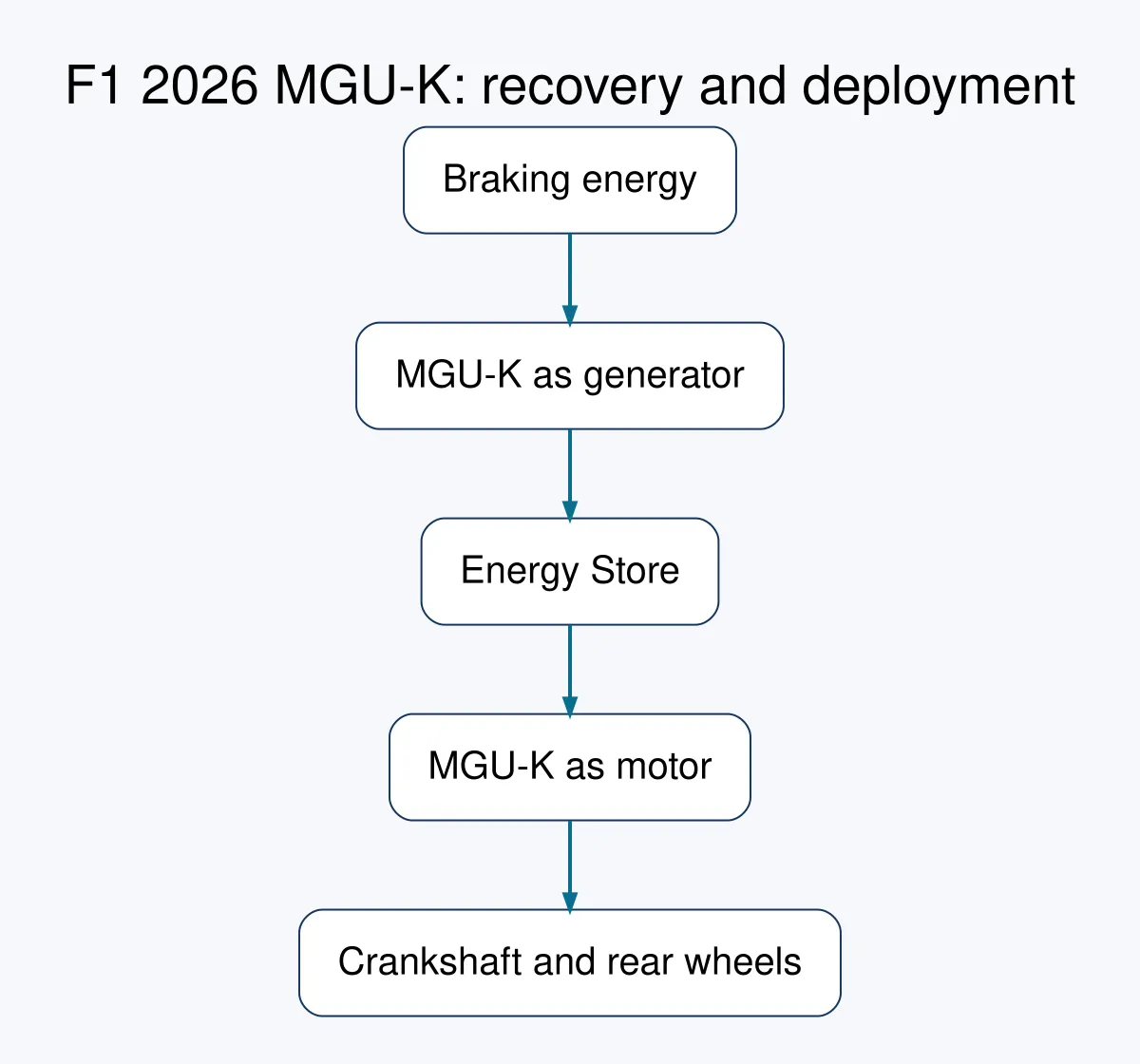
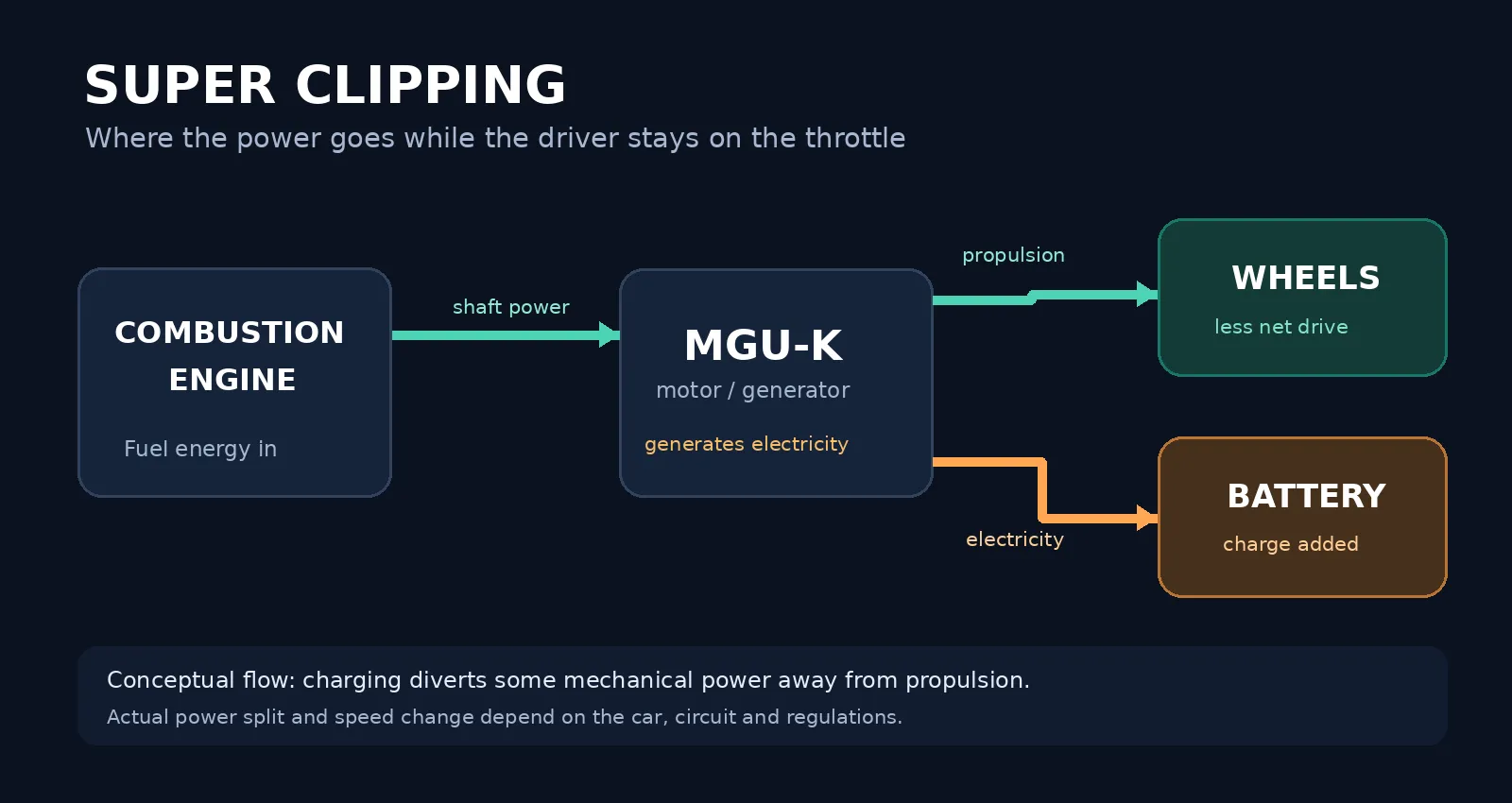
If the following car spent energy earlier, it may need to recover it later. That is where super clipping becomes relevant: charging at full throttle can trade speed now for usable energy elsewhere. For a diagram of the machine carrying out the recovery and deployment, see our MGU-K guide. The distinction between moving wings and electrical advantage is covered in our active-aero comparison.
Does Overtake Mode replace DRS?
As a race overtaking aid, yes: Formula 1 says Overtake Mode replaces DRS’s proximity-gated assistance. Mechanically, it does something different. DRS opened part of the rear wing under its old conditions; 2026 Overtake Mode provides an electrical advantage. The 2026 wings still move, but Straight Mode is separately available in its zones without the one-second requirement. “New DRS” is therefore a loose broadcast shortcut, not a precise engineering explanation.
What should you watch for on television?
First, note whether the car is following another at the detection point. Second, watch the next lap and listen for the commentator’s distinction between Overtake availability and a Boost press. Third, note whether the straight is an active-aero zone. A speed trace alone cannot identify which setting produced a gap: changing drag, different recovery phases and fuel or tyre effects can matter. Without reliable telemetry or team confirmation, attribute only what is actually shown or officially stated.
Sources and scope
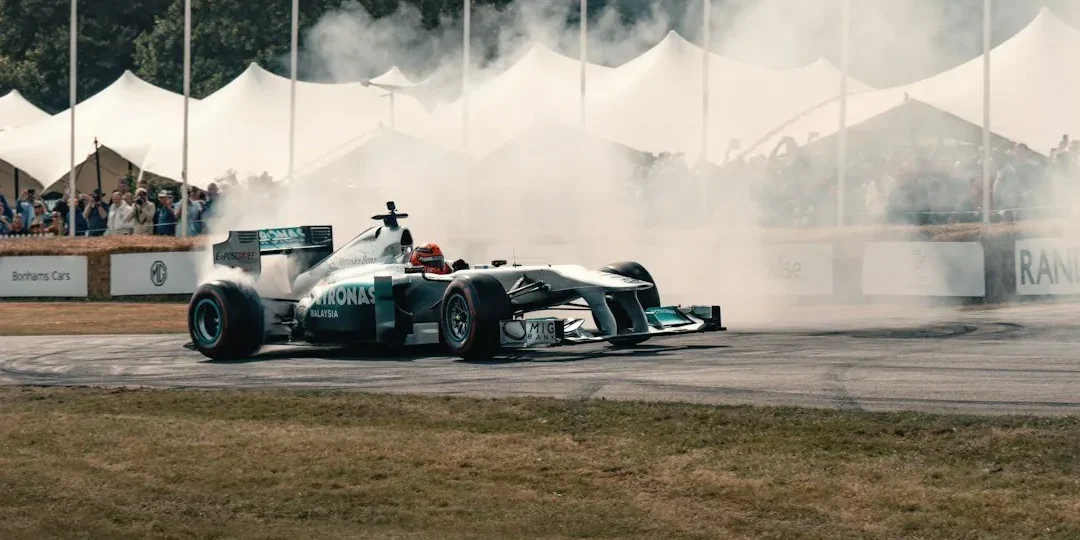
Checked against Formula 1’s official 2026 terminology, its power-unit explainer, and the FIA’s 20 April 2026 refinement. The comparison and decision map are original editorial visual aids. They do not depict measured power or energy traces. Rules may vary by event and be amended; consult the current FIA regulation index and event documents for precise application. Last reviewed September 27, 2026. Featured photograph by Abhinand Venugopal on Unsplash shows a historic Mercedes F1 demonstration at Goodwood. It does not show a 2026 car or establish a power setting.
RELATED POSTS
View all

What Is the MGU-K in a 2026 F1 Car? Energy Flow Explained
September 27, 2026 | by EngineGeek Editorial
F1 Super Clipping Explained: Why Cars Recharge at Full Throttle
September 25, 2026 | by EngineGeek Editorial
2026 F1 Hybrid Engine Explained: V6, MGU-K, Battery and Energy Flow
October 2, 2026 | by EngineGeek Editorial