


F1 Front Wing Aerodynamics: How It Creates Downforce and What Changed in 2026
October 2, 2026 | by EngineGeek Editorial
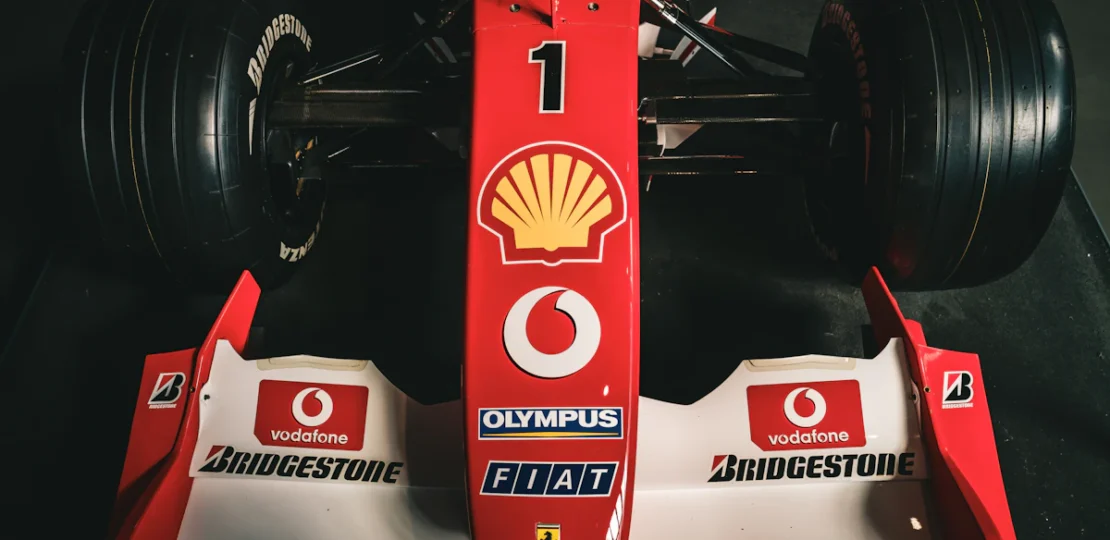
The front wing is the first major aerodynamic surface to meet oncoming air. Its shape helps push the front of an F1 car into the track, but its other job is just as important: influencing the air that reaches the tyres, floor and rest of the car. This guide focuses on that component. For the whole-car picture, start with our F1 aerodynamics overview.
How does the front wing create downforce?
A wing profile changes the speed and pressure of the air around it. Formula 1’s technical explanation describes lower pressure beneath the front wing than above it, producing a net downward force. Its several elements can shape that pressure distribution and manage flow between them. The wing also produces aerodynamic drag, so the most aggressive shape is not automatically the fastest over a lap.
The load is applied near the front axle. That can improve front-end grip and turn-in when the tyres can use it, but the car must remain balanced with its rear. If the rear has proportionally more grip, the car may understeer; if the front is much stronger, the rear may feel unstable. This is a simplified explanation: tyre condition, suspension, ride height and driver inputs also change what is felt.
Airflow map: what happens at the nose
| Air approaching the car | At the wing | Downstream consequence |
|---|---|---|
| Clean air reaches the nose | Wing profiles create a pressure difference | Front axle gains aerodynamic load |
| Air meets the front tyres | Wing and endplate geometry influence the path of the flow | Tyre wake affects the floor and surfaces farther back |
| Designated straight in 2026 | Active front flap moves to Straight Mode with the rear system | Lower incidence helps reduce drag; load is also reduced |
| Corner section in 2026 | Flap returns to Corner Mode | Higher-downforce configuration supports cornering |
Why the front tyres make wing design difficult
A rotating front tyre creates a broad, disturbed wake. Air sent toward the underside of the car and along its sides therefore depends partly on what happens at the front wing and around the wheel. Earlier designs often tried to send some wake outward, a practice known as outwash. That can help parts of the leading car receive cleaner flow, yet it can make the wake behind it more disruptive for a following car.
The FIA explains that the 2026 regulations tightened areas that could be used to create outwash, including the front wing endplates. Formula 1 describes a simplified front wing and flow-directing pieces behind the wheels. The intention is to improve the ability to follow another car, though actual results depend on how teams develop their designs and how cars behave on track.
What is different about the 2026 front wing?
The 2026 front wing is 100 mm narrower than the preceding design, according to the FIA, and incorporates movable flap elements. Both front and rear wings can change between Corner Mode and Straight Mode. With the flaps in the corner configuration, the car has its higher-downforce wing setting. On eligible straight sections, opening them lowers their angle and reduces drag, while also reducing aerodynamic load.
The front wing moves in coordination with the rear wing. Formula 1 explains that this helps maintain balance as the rear wing changes state. This is important because reducing rear load alone could strongly change handling. Active aero is available at designated points regardless of whether the driver is within one second of another car; the separate electrical Overtake Mode has its own eligibility conditions. See our active aero versus DRS comparison for the distinction.
What does the actual rule say about movement?
The FIA’s August 2026 technical regulations, Section C, Article C3.10.10, describe a Corner Mode position and a Straight Mode position with decreased incidence of the primary and/or secondary front wing flap. They specify two fixed positions, require the system to return to Corner Mode on failure and limit the transition time to 400 milliseconds. These are regulatory design requirements; they are not a claim that every team has the same flap angle, load or drag.
Teams can also make certain mechanical adjustments while the car is stationary, within the rules. That is different from the driver-controlled active movement on track. A front-wing adjustment in the garage or during a pit stop may address car balance for particular conditions, whereas switching aero modes is part of the 2026 system’s operation.
Front wing setup: why more angle is not always better
Increasing a wing’s angle can generally increase pressure difference and front load, but it often adds drag and may disturb flow or lose efficiency. A circuit with long straights rewards a different compromise from a circuit dominated by slow corners. A team evaluates the complete car: front load, rear stability, underfloor performance, tyres and energy use all affect lap time.
A useful way to watch the car is to separate two questions: does it have enough front grip to turn, and does the aerodynamic balance remain stable as speed or the wing mode changes? A faster straight-line speed alone cannot establish that a front-wing design is superior.
Quick answers
Does the front wing work at low speed?
Yes, but aerodynamic force is much smaller at lower speed than at higher speed under similar conditions. Mechanical grip contributes more of the driver’s available cornering force at slow corners.
Is the 2026 front wing simply the old DRS at the front?
No. The 2026 system adjusts front and rear wing elements together at designated locations. Its use does not require the one-second gap that governed the former DRS race activation. The separate Overtake Mode concerns additional electrical energy.
Can the front wing alone explain dirty air?
No. Tyres, floor, diffuser, rear wing and the complete car shape all influence the wake. The front wing affects the first stages of the airflow path and can influence what reaches downstream components.
Sources and scope
This explanatory guide draws on FIA 2026 Technical Regulations, Issue 20, Article C3.10.10, the FIA 2026 overview, Formula 1’s 2026 aerodynamics guide and Formula 1’s front-wing technical explanation. The 2022 article is used only for the underlying aerodynamics, not as a statement of current 2026 dimensions. The flow map is an original qualitative teaching aid.
RELATED POSTS
View all

F1 Aerodynamics Explained: Downforce, Drag, Wings and the 2026 Floor
October 2, 2026 | by EngineGeek Editorial
F1 Active Aero vs DRS: Straight Mode, Corner Mode and Overtake Mode
September 25, 2026 | by EngineGeek Editorial