


350 kW vs 250 kW in F1 2026: MGU-K Zones and Super Clipping Explained
September 30, 2026 | by EngineGeek Editorial
The answer in one minute
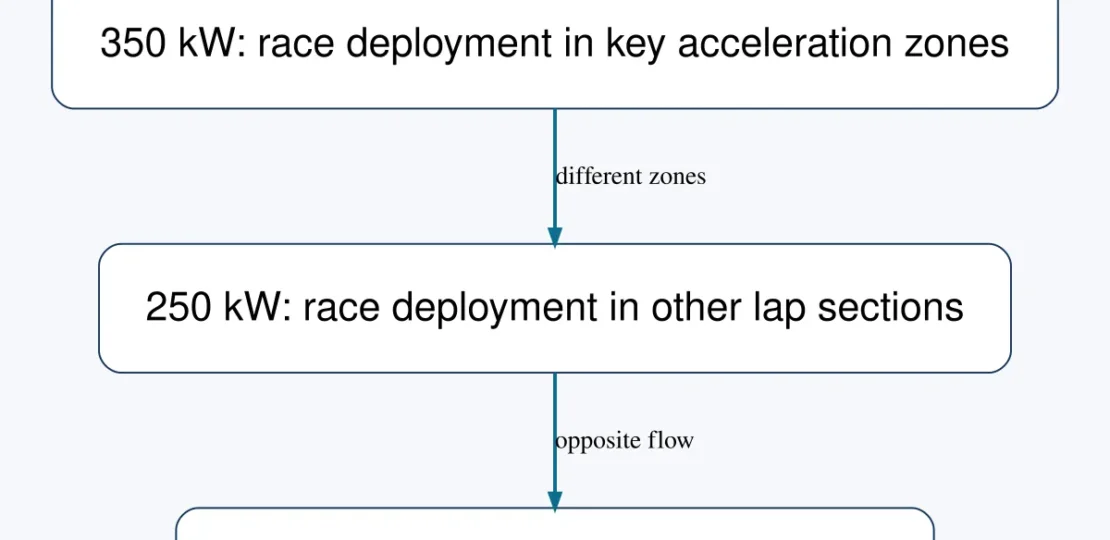
The FIA’s April 2026 refinement describes two race deployment limits for the MGU-K: up to 350 kilowatts (kW) in key acceleration zones, from corner exit to the braking point and including overtaking zones, and 250 kW in other parts of the lap. These are limits on the electrical motor-generator’s deployment in the specified context, not two fixed speeds for the car. The same announcement raised the peak power for super clipping, a form of energy recovery at full throttle, from 250 to 350 kW. Equal numbers can describe opposite directions of energy flow.
The comparison: where the number applies
| Parameter | 350 kW reference | 250 kW reference | Direction and context |
|---|---|---|---|
| MGU-K race deployment | Maintained in key acceleration zones | Limited in other parts of the lap | Electrical energy goes to the rear wheels |
| Peak super-clipping recharge | Raised to 350 kW in the April refinement | Previous 250 kW peak | Energy is recovered while the driver remains at full throttle |
| What the number does not tell you | A car’s speed or sustained output | A universal throttle setting | Actual use depends on zone, battery state, control strategy and event rules |
The table compares the figures in the FIA’s 20 April 2026 announcement. It is a rule comparison, not a trace of a real lap. To identify the exact zones or energy limits for a particular race, read the FIA’s current regulations and that event’s power-unit information. A line drawn around an imaginary circuit would risk implying the same zone layout applies everywhere.
Power is not speed, and it is not energy
A kilowatt measures the rate at which energy is transferred. A megajoule (MJ) measures an amount of energy. If a motor delivered 350 kW for exactly one second, it would transfer 0.35 MJ. At 250 kW for exactly one second, it would transfer 0.25 MJ. The 100 kW difference is 40% of 250 kW; 250 kW is about 71% of 350 kW. These are arithmetic comparisons of ceilings, not predictions of acceleration, lap time or a car’s actual deployment.
Vehicle speed depends on the combustion engine, drag, downforce, gearing, mass, tyre grip, battery state and where the energy is used. Electrical power can also taper with speed under a specified power profile. A broadcast that shows 250 kW at one moment therefore cannot establish that the driver selected a weaker mode or that the system was at its limit. It may show a permitted zone, a control choice or another constraint.
What counts as a key acceleration zone?
The FIA described these race zones as stretching from corner exit to braking point, including overtaking zones. It did not say that every moment of an entire lap permits the 350 kW ceiling. The other parts of the lap have a 250 kW deployment limit under the announced refinement. The boundaries and power profiles are operational details, so do not infer a universal map from the phrase “key acceleration.” Check the relevant Grand Prix documents before labelling a corner or straight.
Consider a conceptual sequence: a driver exits a slow corner, accelerates along a straight and eventually brakes. The key acceleration section could permit the higher deployment ceiling; another section of the same lap may be subject to the lower ceiling. The motor need not use its full permitted power in either. The team must balance energy to be used now with energy needed later. The sequence illustrates a principle, not telemetry or the official zone map for any circuit.
Why does super clipping also say 350 kW?
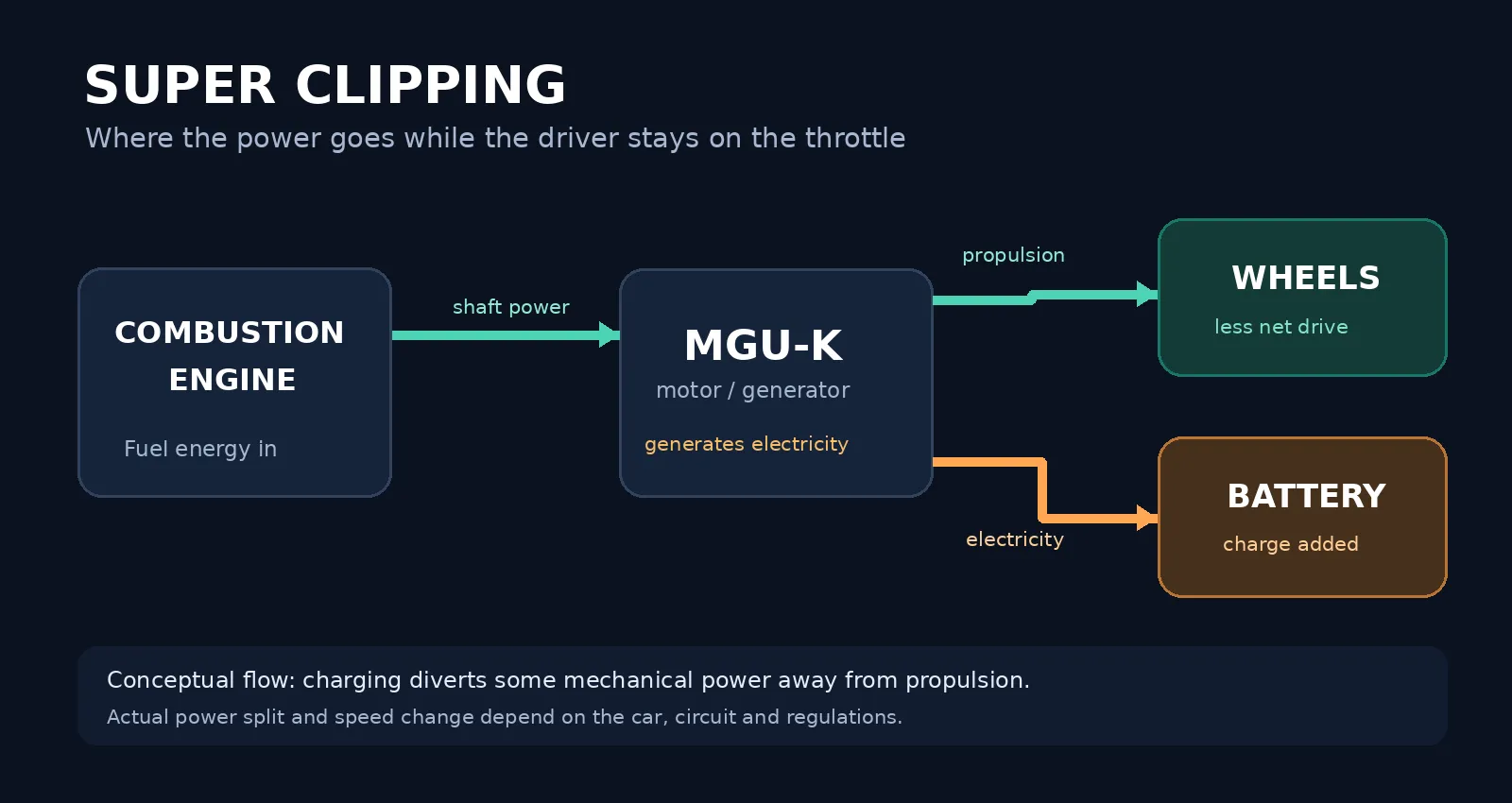
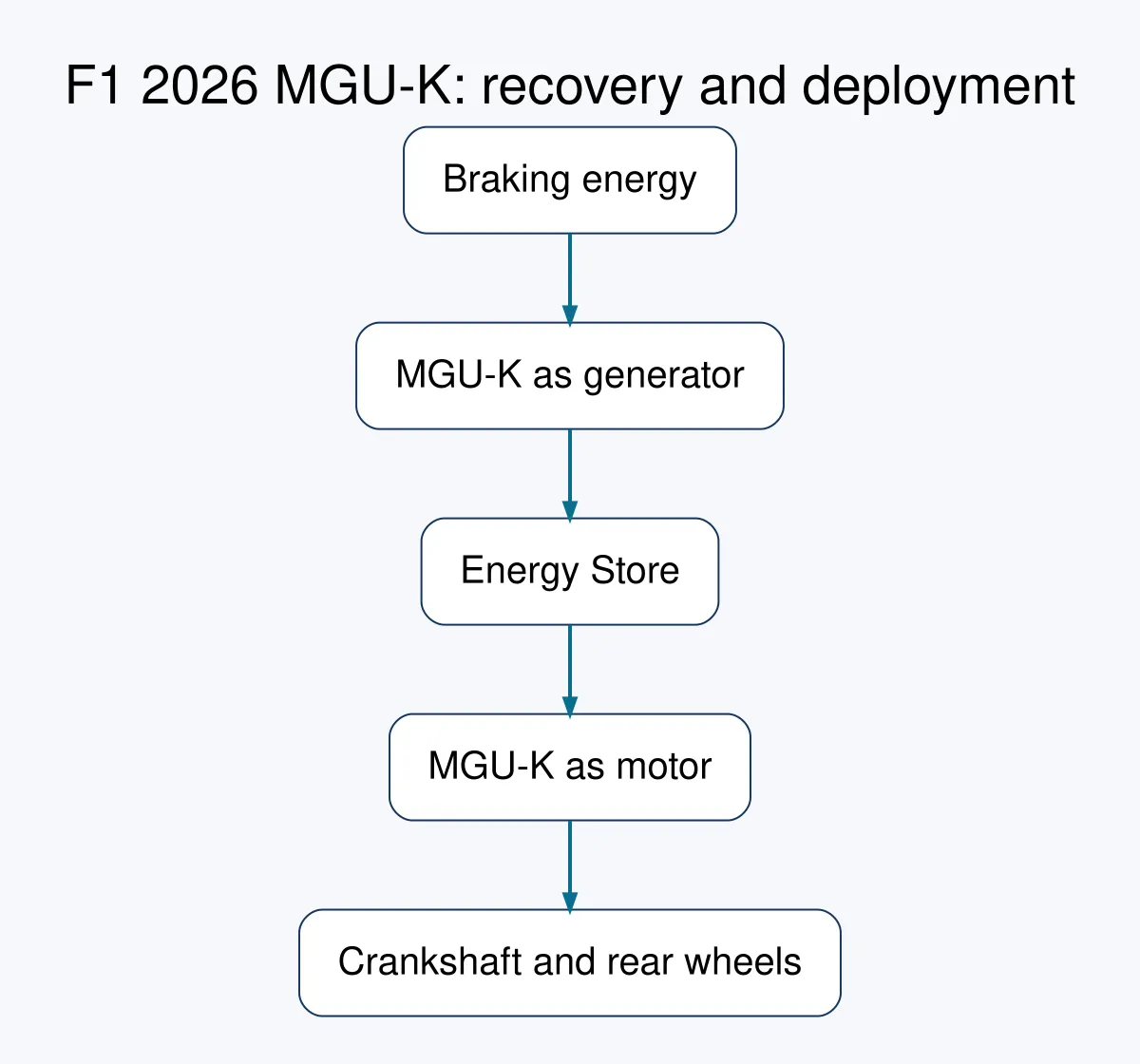
When the MGU-K helps propel the car, electrical energy flows from the energy store through the motor-generator toward the wheels. During super clipping, it can instead harvest while the driver is still at full throttle near the end of a straight. Formula 1’s power-unit explainer describes that unusual full-throttle harvesting alongside recovery during braking, partial throttle and lift and coast. The FIA raised the peak super-clipping figure from 250 to 350 kW in April to reduce time spent recharging. That is a recharge figure, not a promise that the car adds 350 kW to the wheels while harvesting.
This difference matters when a car appears to stop gaining speed despite full throttle. Electrical deployment might taper or end, and harvesting might begin. The precise cause in any televised example requires reliable telemetry or team information. Our super-clipping guide follows the flow in more detail, while the MGU-K guide explains why one device can perform both jobs.
How Boost and Overtake fit
Boost is a driver-operated energy deployment tool. The FIA’s April race refinement also capped the maximum power available through Boost in race conditions at +150 kW, or the car’s current power at activation if higher. Overtake Mode is a separate proximity-dependent allowance for a car within one second at the detection point. Neither label turns the 350/250 kW zone distinction into a universal constant output. The driver’s available electrical performance still sits within the applicable rules and energy budget. Our Boost vs Overtake comparison separates those controls and the wing modes.
Does the rule apply to qualifying too?
The 350/250 kW deployment distinction in the FIA announcement is expressly presented under its “Race” section. Its “Qualifying” section discusses a different change: reducing maximum permitted recharge from 8 MJ to 7 MJ and increasing peak super-clipping power from 250 to 350 kW. It also allows alternative lower energy limits at more events. Do not transfer a race deployment zone rule into qualifying by reading the two paragraphs as one. See our 7 MJ qualifying guide for the unit difference and event caveat.
Three checks when you hear a power number
- Ask whether the number concerns deployment to the wheels or harvesting into the energy store.
- Check whether the claim is about a race, qualifying or a specific event note.
- Separate an instantaneous kW ceiling from an MJ energy allowance and from measured performance.
Sources and review: FIA, 20 April 2026; Formula 1 power-unit explanation; current FIA regulation index. Arithmetic and conceptual examples are EngineGeek’s own and do not represent team telemetry. Reviewed 29 September 2026; event documents and later rule issues take precedence for a specific Grand Prix.
RELATED POSTS
View all

F1 Super Clipping Explained: Why Cars Recharge at Full Throttle
September 25, 2026 | by EngineGeek Editorial
What Is the MGU-K in a 2026 F1 Car? Energy Flow Explained
September 27, 2026 | by EngineGeek Editorial
2026 F1 Hybrid Engine Explained: V6, MGU-K, Battery and Energy Flow
October 2, 2026 | by EngineGeek Editorial