


What Does 7 MJ of Recharge Mean in F1 Qualifying? Energy vs Power Explained
September 27, 2026 | by EngineGeek Editorial
The short answer
For most 2026 qualifying sessions after the Miami rule refinement, the FIA reduced the maximum permitted recharge from 8 megajoules (MJ) to 7 MJ. That number limits energy recovered under the relevant qualifying rules; it is not a 7 MJ battery-capacity specification and it does not mean the MGU-K delivers 7 MW of power. The FIA also raised peak super-clipping power from 250 to 350 kilowatts (kW), with the stated aim of spending less time harvesting at full throttle. Circuit-specific lower energy limits can apply, so the event documents and current regulations are the final reference.
MJ and kW answer different questions
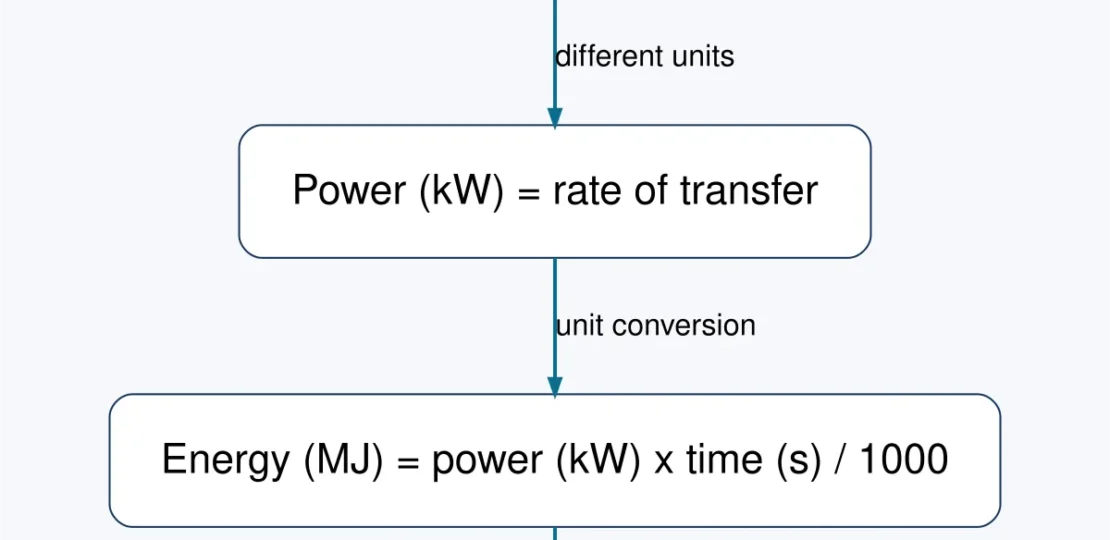
An MJ is an amount of energy; a kW is a rate of energy transfer. A useful analogy is the amount of water in a tank versus the rate at which a tap fills it. One MJ equals about 0.278 kilowatt-hours (kWh), so 7 MJ equals about 1.94 kWh. This is a unit conversion, not a claim that a 2026 F1 battery stores 1.94 kWh or that the full allowance must be harvested on every lap.
Power multiplied by time gives energy: 350 kW for one second corresponds to 0.35 MJ. Dividing 7 MJ by 350 kW produces 20 seconds mathematically. That calculation is only a constant-power illustration. A real qualifying lap changes power with speed, braking and the car’s control strategy; the FIA’s limit, other constraints and track-specific documents determine what is permitted. You cannot derive a team’s actual battery state or recharge duration from this division.
What changed in April 2026?
The FIA’s 20 April 2026 announcement set out a package intended for implementation from Miami, subject to its stated approval process. For qualifying, it described a reduction in maximum permitted recharge from 8 to 7 MJ and an increase in peak super-clipping power from 250 to 350 kW. It estimated a target maximum super-clipping duration of approximately two to four seconds per lap; that was the FIA’s goal, not a measured time for every car and circuit.
| Measure | Before announced refinement | After announced refinement | What it describes |
|---|---|---|---|
| Maximum permitted qualifying recharge | 8 MJ | 7 MJ | Energy allowance, with event-specific limits possible |
| Peak super-clipping power | 250 kW | 350 kW | Instantaneous ceiling for that harvesting method, not sustained power |
| FIA target for maximum super-clipping duration | Not stated as a universal measured value | Approximately 2–4 seconds per lap | Stated target, not telemetry |
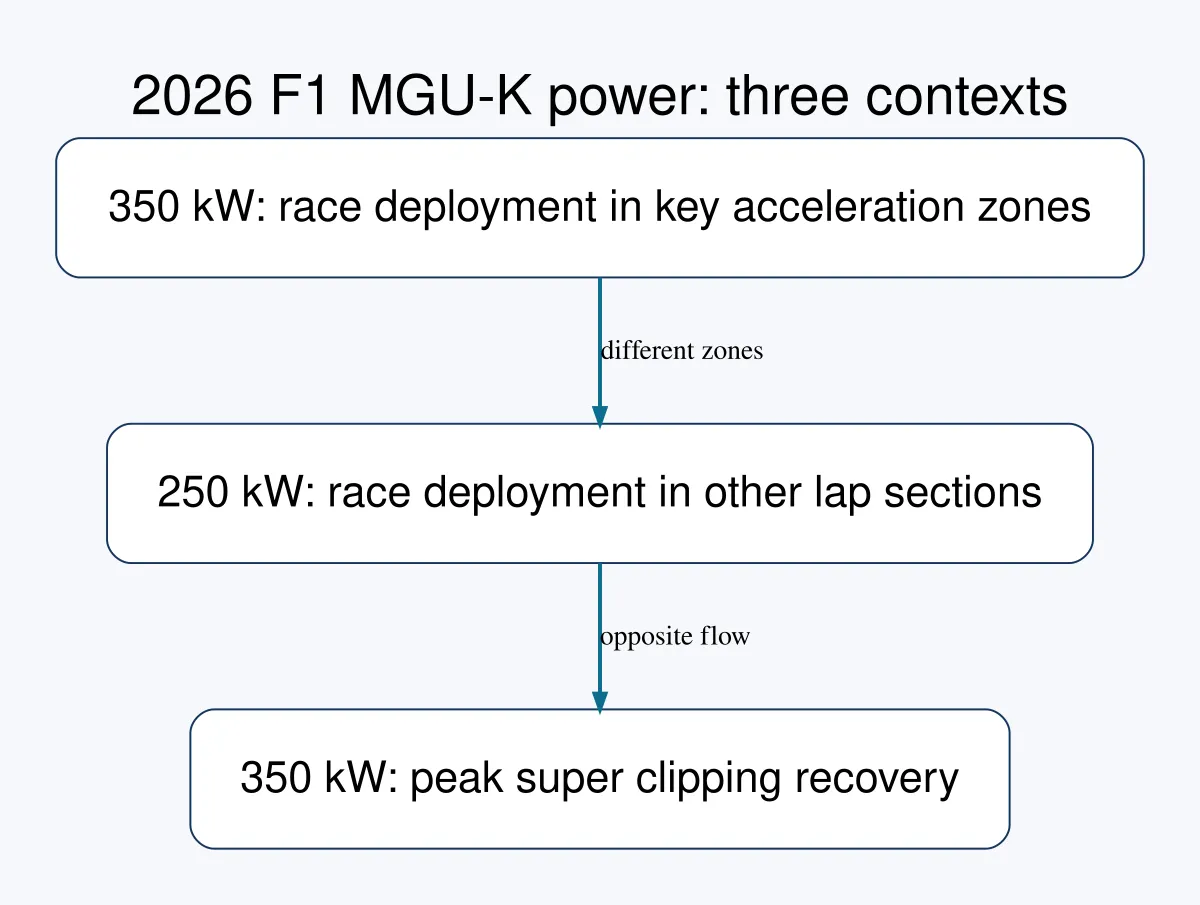
The same FIA announcement said the number of events where alternative lower energy limits may apply increased from eight to twelve. Therefore, quoting “7 MJ in every session” without an event check would be too strong. It also said the 350 kW peak super-clipping change would apply in race conditions; the 7 MJ statement here specifically concerns qualifying. Our 350 vs 250 kW guide separates race deployment zones from that recharge figure. Rules can change again, so use the FIA’s current regulation index and any event notes when assessing a particular Grand Prix.
Why reduce the energy allowance while raising a power ceiling?
The two changes affect different dimensions. The lower maximum recharge narrows the allowed energy total under the relevant qualifying parameters. The higher peak power can permit a faster instantaneous harvest during a super-clipping phase, potentially reducing how long a driver spends in that phase. That is the logic in the FIA announcement. It does not prove that a car will accelerate more strongly at a particular point; engineers still allocate electrical energy across the lap and manage other constraints.
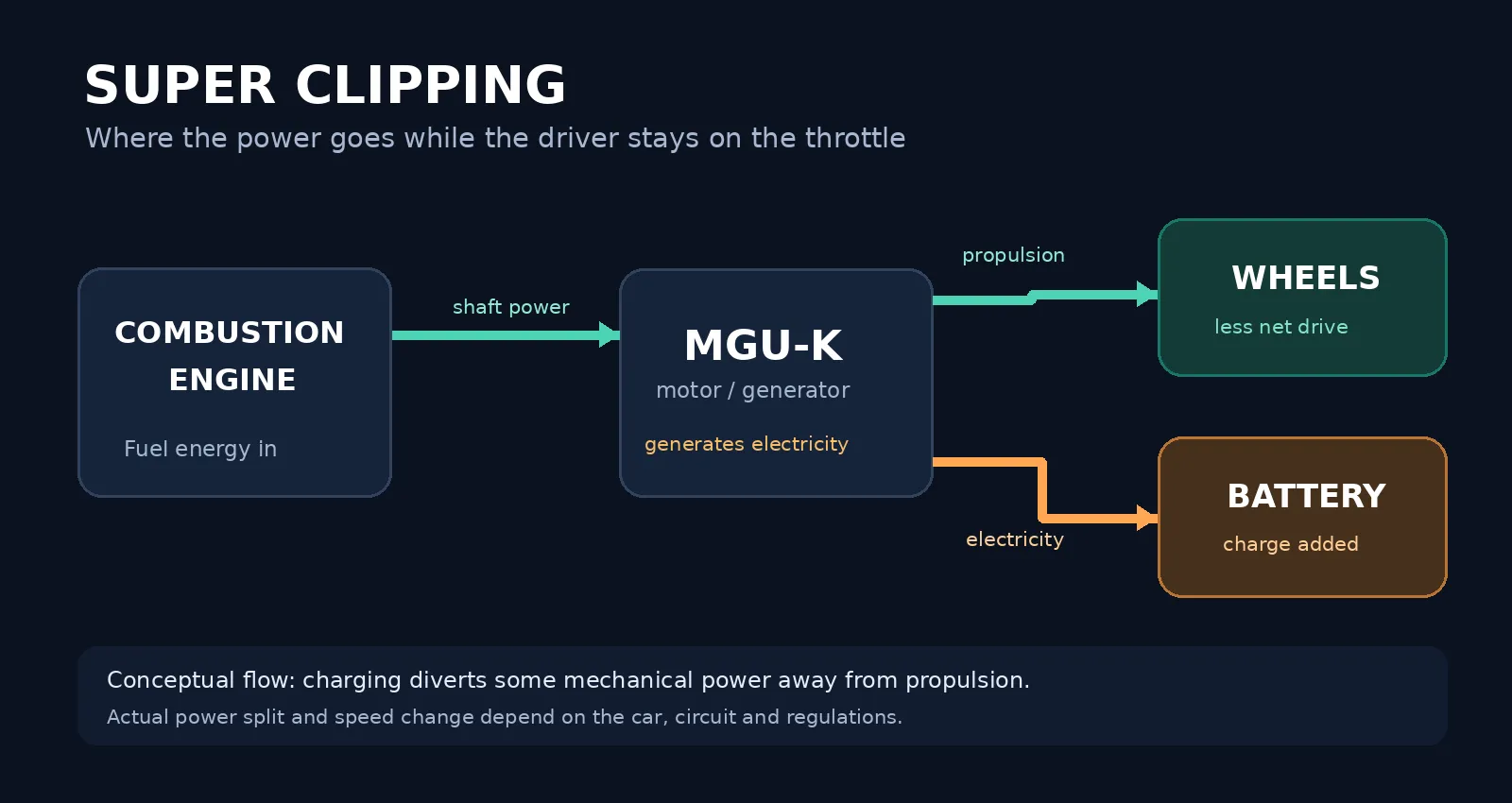
Formula 1’s power-unit explainer describes several ways a 2026 car can recover energy: braking, partial throttle, lifting before a corner and super clipping at full throttle near the end of a straight. The energy source and trade-off differ. Under super clipping, some available power is diverted to recharge while the driver is still flat out; slower acceleration or a speed drop can result. Under lift and coast, the driver eases off the accelerator earlier. A TV graphic showing a depleted battery does not by itself identify which method a team used.
A lap example without invented telemetry
Imagine a long straight followed by a heavy braking zone. The car may deploy electrical energy out of the preceding corner, then reduce deployment and potentially harvest at full throttle later on the straight; braking can recover more energy for subsequent acceleration. On another circuit, the optimal distribution may differ. This is a conceptual sequence, not a trace from any team. The precise amount recovered in each phase cannot be inferred from the 7 MJ limit alone.
Does a higher super-clipping ceiling contradict a lower recharge allowance?
No. An energy allowance is an accumulated quantity, while a power ceiling describes an instantaneous rate. A driver can, in principle, recover energy at a higher rate for a shorter period while staying within a lower overall allowance. Think of filling a smaller permitted volume through a wider pipe for less time. This does not tell us the precise time a particular team will choose, because the battery state, deployment demands, braking opportunity and circuit layout all matter.
Is the 7 MJ figure the amount deployed by Overtake Mode?
No. Overtake Mode concerns extra electrical energy available to a following car at the specified detection point in a race. Its one-second eligibility and additional allowance belong to a different rule and session context. The qualifying recharge figure here does not specify the energy available for a single pass. Read our Boost and Overtake comparison before comparing the numbers.
Common mistakes
- “7 MJ is the battery size.” No: this figure refers to permitted recharge in the qualifying context described by the FIA.
- “350 kW is supplied for an entire lap.” No: it is a peak super-clipping figure for harvesting, not a continuous output claim.
- “Less recharge always means a faster qualifying lap.” No: that is a rule objective; lap outcome depends on track and strategy.
- “The same limit applies at every race.” Check the event documents for alternative lower limits.
What to read next
For the mechanism, read our super-clipping guide. For the motor-generator’s two-way energy flow, see what the MGU-K does. To separate a driver’s deployment choice from an overtaking allowance, see Boost vs Overtake Mode. Our F1 engineering index groups the full series.
Editorial note: This article interprets the FIA announcement of 20 April 2026 and the Formula 1 power-unit explainer. It uses a unit conversion and a hypothetical constant-power calculation, explicitly not team telemetry. Reviewed 27 September 2026; check the latest FIA regulations and event documents for a specific session.
RELATED POSTS
View all

F1 Super Clipping Explained: Why Cars Recharge at Full Throttle
September 25, 2026 | by EngineGeek Editorial
350 kW vs 250 kW in F1 2026: MGU-K Zones and Super Clipping Explained
September 30, 2026 | by EngineGeek Editorial
F1 Boost vs Overtake Mode in 2026: Power, Energy and the One-Second Rule
September 27, 2026 | by EngineGeek Editorial