


F1 Super Clipping Explained: Why Cars Recharge at Full Throttle
September 25, 2026 | by EngineGeek Editorial
2026 F1 technology, made simple. A car can recharge its battery near the end of a straight even while its driver keeps the accelerator pressed. That apparent contradiction is called super clipping.
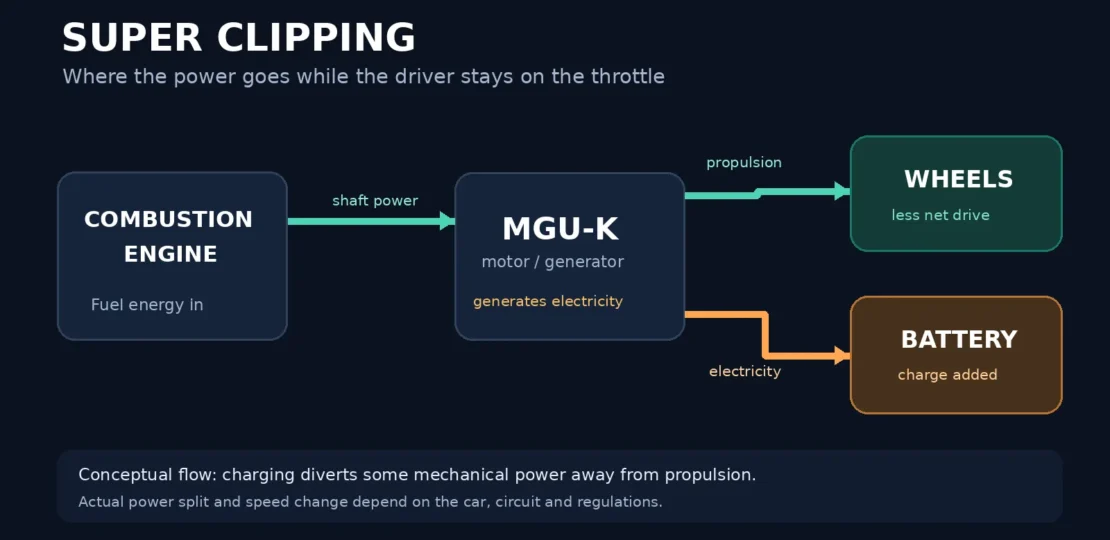
Picture two demands on the same power unit: turn available energy into forward motion now, or store some of it for a more valuable part of the lap. Super clipping favors the second option for a moment. The engine is still working and the driver is still at full throttle, but the MGU-K operates as a generator rather than adding electric drive. It takes mechanical energy that could otherwise contribute to propulsion and converts it into electrical energy for the battery. That is why a car can stop accelerating as strongly, or even slow, before the braking zone.
The short answer
Super clipping is on-throttle energy recovery. It differs from conventional regenerative braking because the driver has not pressed the brake pedal. It differs from lift-and-coast because the driver has not lifted off the accelerator. The strategy is largely managed by the car’s energy maps and electronics, rather than a separate button the driver presses each time. Formula 1 notes that its use depends on the engine map, circuit and permitted recharge allowance.
Why would a team sacrifice speed on a straight?
The answer is lap-time tradeoff. The 2026 power unit relies much more heavily on electrical power than its predecessor. The 2026 MGU-K was designed for up to 350 kW of electrical output, compared with 120 kW under the previous rules, as Formula 1 explains. That figure is a ceiling, not constant race deployment: the FIA’s 20 April 2026 update limits MGU-K use to 350 kW in key acceleration zones and 250 kW in other sections of the race lap, with a separate temporary Boost allowance. The same update raised peak super-clipping recharge power from 250 to 350 kW. For the separate qualifying energy allowance and why MJ differs from kW, see our 7 MJ recharge explainer. Actual use still depends on the event-specific limits and available battery energy (FIA, 20 April 2026). A team cannot spend battery energy everywhere without replenishing it. Braking zones supply some recovered energy, but the amount and timing differ between circuits and driving conditions.
Charging late on a straight can prepare the battery for acceleration out of a following corner or for another strategically valuable section. The calculation is not simply “more charge is always better”: the immediate loss of wheel power must be weighed against the later benefit of electrical deployment. A circuit with long straights and relatively few hard braking zones can make that balance especially visible. This is a conceptual explanation, not a claim that every team uses the same strategy or that every visible speed drop is super clipping.
Full throttle does not mean maximum wheel power
The accelerator tells the power unit what the driver is asking for; the resulting energy flow also depends on the chosen operating map and the rules. The combustion engine can continue producing power while the MGU-K harvests some mechanical energy. Less net power is then available to propel the car than if the system were not harvesting. At high speed, aerodynamic drag is substantial, so a reduction in net drive can be noticeable even with the throttle pedal down.
Our diagram shows the direction of energy flow, not a precise mechanical layout, measured power split or telemetry trace. Teams’ calibration details are not public, and the FIA has updated the 2026 technical regulations during the season. Avoid treating any single illustration or lap as a universal setting.
How is it different from other ways to recharge?
| Method | Driver input | When energy is recovered |
|---|---|---|
| Regenerative braking | Braking | The MGU-K harvests while the car slows for a corner. |
| Lift-off recovery | Accelerator released | Energy is recovered while the driver coasts. |
| Part-throttle recovery | Accelerator partly applied | The car harvests while the driver requests less drive. |
| Super clipping | Accelerator fully applied | The MGU-K can still harvest, commonly toward the end of a straight. |
These are descriptions of operating conditions, not four separate batteries. Formula 1 groups them under Recharge. Its explanation also makes a useful distinction: because the driver remains on the throttle during super clipping, the car can keep its active aero in the open straight-line configuration; lifting off can close those devices.
Does super clipping replace DRS?
No. It is a way to recover energy, not an overtaking aid. For 2026, moveable front and rear wing elements provide active aerodynamics in designated sections. A separate Overtake Mode is available to a following driver who meets the proximity condition at the detection point. Boost refers to a driver-operated deployment tool; this comparison of Boost and Overtake Mode explains the distinct eligibility and power limits. Confusing these three systems leads to misleading explanations of why a car gains or loses speed.
What to watch during a race
Watch a long straight after the initial burst of acceleration. A car may gain speed rapidly and then gain less—or lose speed—before the braking point. That pattern alone cannot prove super clipping: wind, drag, gearing, fuel, deployment and the driver’s inputs also matter. Reliable confirmation needs telemetry or a specific explanation from the team or broadcaster. The important idea is that the fastest use of energy over an entire lap can look slower for a few seconds on one part of it.
Sources and editorial note
This explanation was checked against Formula 1’s 2026 terminology guide, its 2026 power-unit explainer, and the FIA’s current regulation index. The diagram and the comparison above are EngineGeek’s own explanatory work. We will review this article if the regulations or official terminology change.
RELATED POSTS
View all

F1 Boost vs Overtake Mode in 2026: Power, Energy and the One-Second Rule
September 27, 2026 | by EngineGeek Editorial
What Is the MGU-K in a 2026 F1 Car? Energy Flow Explained
September 27, 2026 | by EngineGeek Editorial
350 kW vs 250 kW in F1 2026: MGU-K Zones and Super Clipping Explained
September 30, 2026 | by EngineGeek Editorial