


2026 F1 Hybrid Engine Explained: V6, MGU-K, Battery and Energy Flow
October 2, 2026 | by EngineGeek Editorial
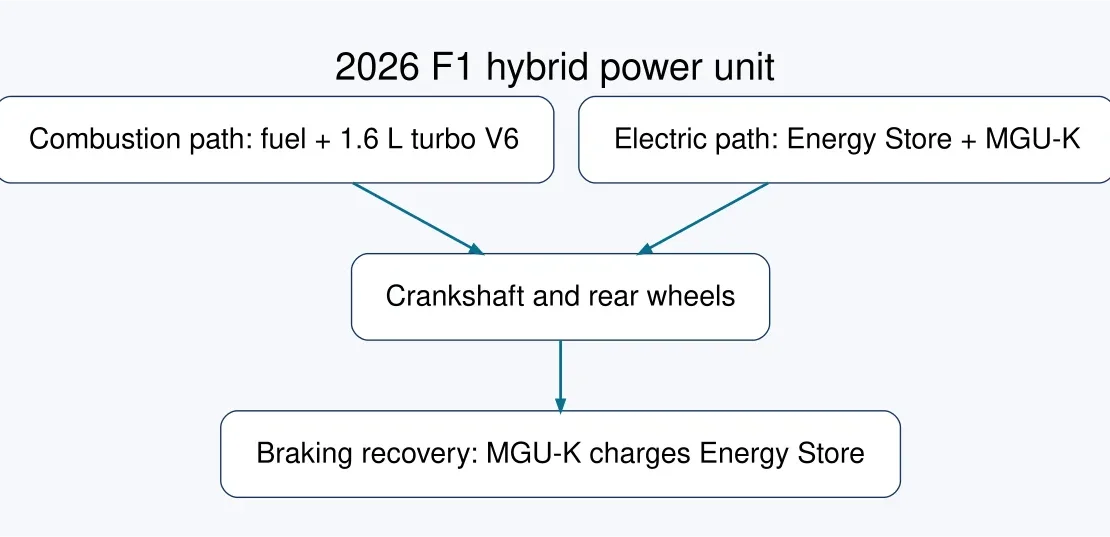
A 2026 Formula 1 car still has a turbocharged V6 engine, but a much larger share of its propulsion can come from electricity. The two systems meet mechanically at the drivetrain: fuel powers the combustion engine, while stored electrical energy drives the MGU-K. The same MGU-K can reverse its role and recover energy. Understanding those paths makes the new rules much easier to follow.
The short answer: what makes it a hybrid?
A hybrid power unit combines an internal combustion engine with an electrical motor-generator and an energy store. The 2026 combustion engine remains a 1.6-litre turbo V6. The MGU-K can supply electrical drive power up to the applicable limits, or act as a generator to recover energy. Formula 1 describes a target of roughly half the power coming from the electrical system in the new formula, versus around one fifth previously. This is a broad design description, not a fixed split at every instant on a lap.
| Part | Energy path | What it contributes |
|---|---|---|
| Turbocharged 1.6-litre V6 | Fuel → combustion → crankshaft | Mechanical power from fuel; remains a major share of propulsion. |
| MGU-K | Energy Store ↔ motor-generator ↔ crankshaft | Adds drive torque or recovers mechanical energy as electricity. |
| Energy Store and control electronics | Electrical energy in and out | Stores energy and manages its permitted transfer; it is not an independent engine. |
| Turbocharger | Exhaust-driven compressor for the V6 | Helps feed the combustion engine. The separate MGU-H used before 2026 is gone. |
How the combustion and electrical paths work together
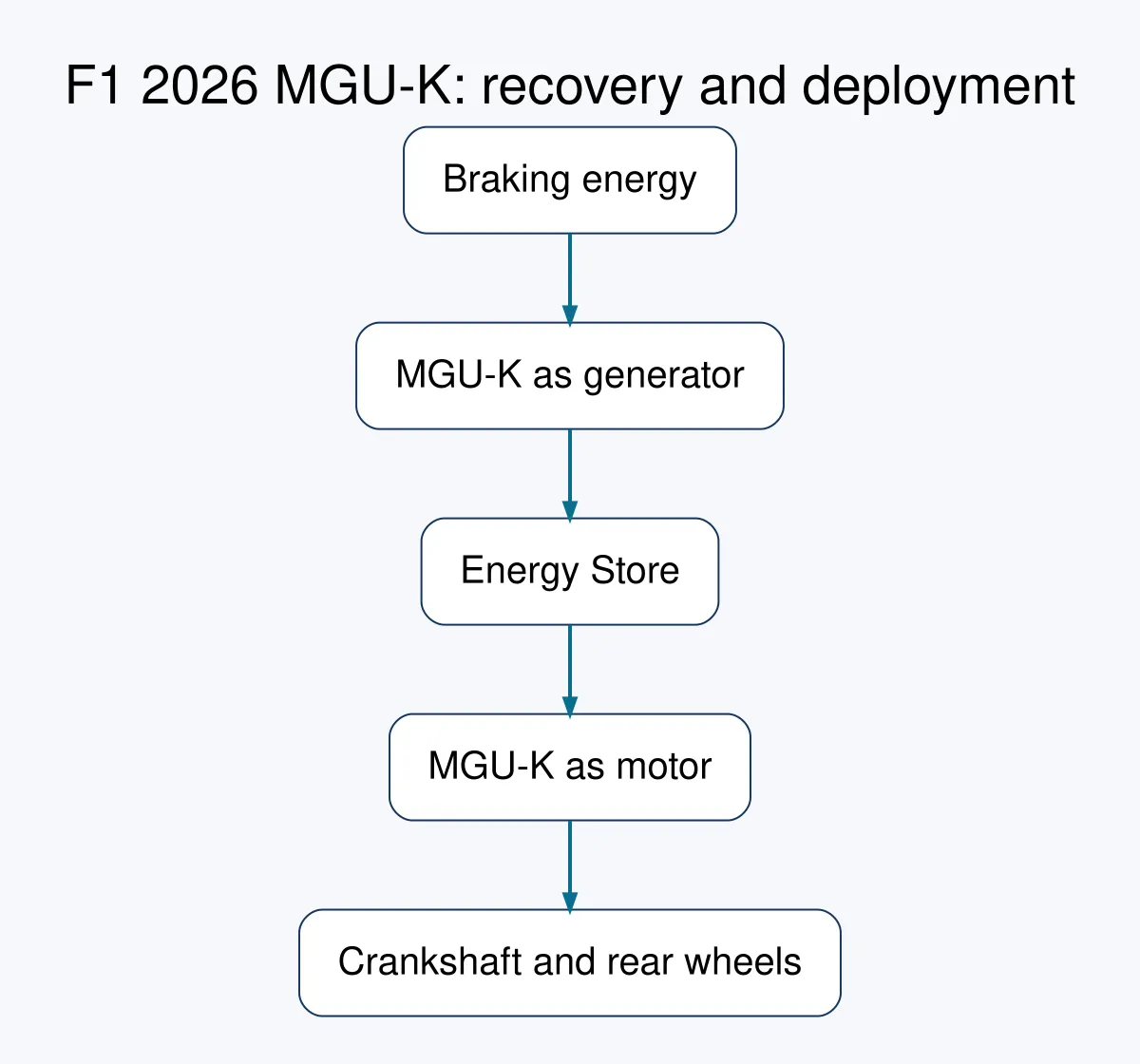
The V6 burns fuel to turn the crankshaft. A turbocharger uses exhaust energy to compress the intake air for that combustion process. The MGU-K is mechanically linked to the engine’s crankshaft under the FIA technical rules. When it motors, electrical energy moves from the Energy Store through the power electronics to the MGU-K, adding torque to the drivetrain and ultimately helping drive the rear wheels.
When the MGU-K generates, mechanical energy is converted into electrical energy and stored. Under braking, some of the kinetic energy that would otherwise be dissipated as heat can be recovered. Other strategies include harvesting during coasting, reduced throttle or, under specific conditions, at full throttle. Our dedicated MGU-K guide traces these two directions in detail, and the super-clipping guide explains the unusual full-throttle case.
What changed from the previous hybrid formula?
The most visible electrical number is the rise in MGU-K capability from 120 kW to 350 kW, as Formula 1 explains. The MGU-H, the former motor-generator associated with the turbocharger, was removed. That does not mean the turbocharger was removed: the 2026 combustion engine is still turbocharged. The power-unit rules also require advanced sustainable fuel under Formula 1’s 2026 programme.
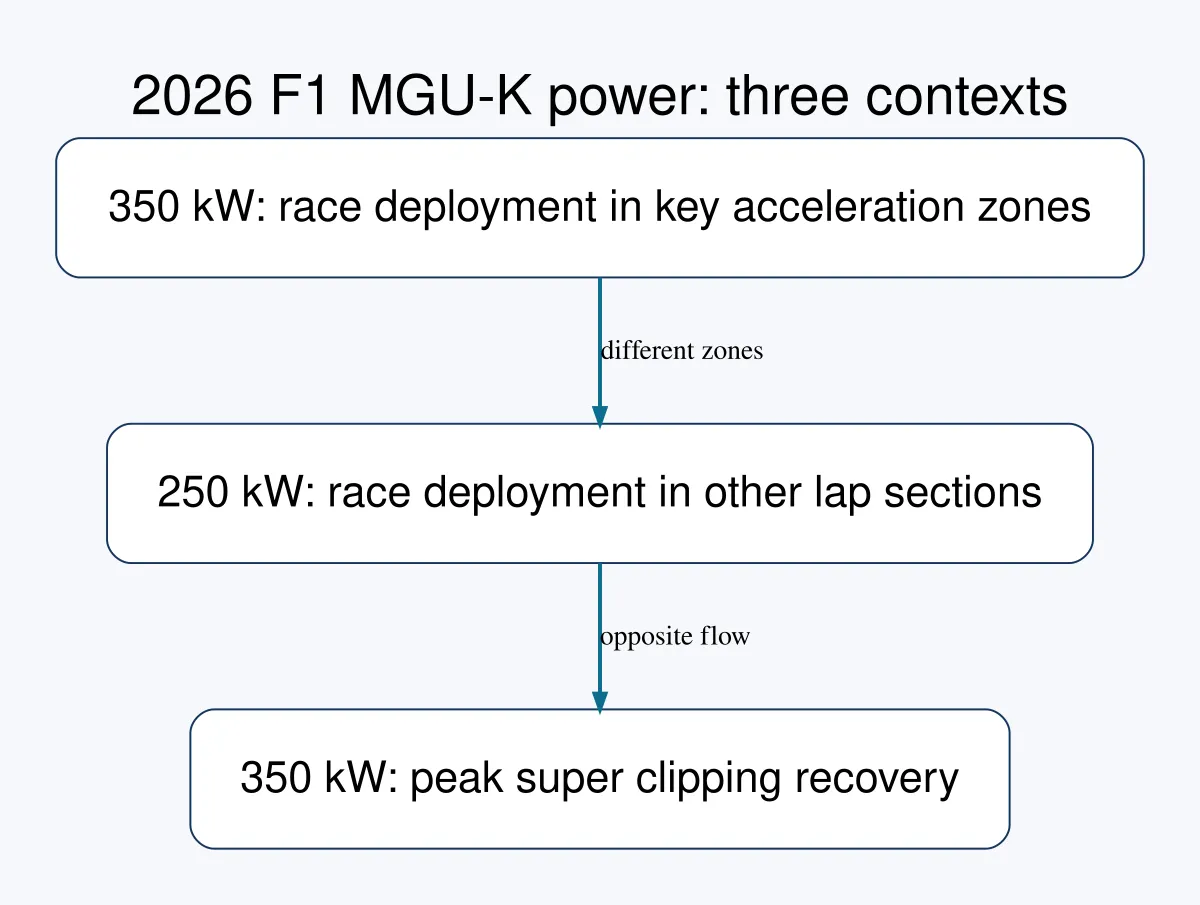
The higher electrical ceiling is not a constant 350 kW delivered everywhere. The FIA’s technical regulations set an absolute ERS-K electrical DC power limit of 350 kW and define speed-dependent deployment profiles, with additional race and event constraints. The FIA’s April 2026 refinement describes 350 kW in key race acceleration zones and 250 kW in other parts of the lap. Read our zone comparison before treating either value as universal.
Keep the units separate: 350 kW is a ceiling on electrical power, while MJ measures an amount of energy. A power ceiling does not tell you how long it can be held or how much energy remains for the lap.
Why does energy management change the driving?
A driver and team must decide where stored electrical energy provides the greatest advantage and where to recover it. Deploying strongly out of one corner may leave less available later; harvesting can affect how the car accelerates or decelerates. Those effects depend on the circuit, the battery state, the permitted limits and the control strategy. A broadcast graphic cannot by itself reveal the team’s complete state of charge or software map.
Active aerodynamics adds another layer. In 2026, the front and rear wings can move to a lower-drag Straight Mode in designated sections, helping a car use its power more efficiently on a straight. This wing change is separate from electrical Boost and Overtake Mode. Our active aero explainer covers the wings, while the Boost versus Overtake guide covers electrical controls.
What does the battery figure actually tell us?
The regulations distinguish the Energy Store’s on-track state-of-charge swing from energy that may be recovered across a lap. In Issue 20 of the FIA 2026 technical regulations, the difference between maximum and minimum state of charge while on track may not exceed 4 MJ. A separate rule can allow more energy to be recovered over a lap because energy may be deployed and replenished during that lap. Therefore, a 7 MJ qualifying recharge limit does not imply a 7 MJ usable battery swing. Our 7 MJ explainer separates energy from power and explains the event caveat.
A lap in four steps: a conceptual example
- Approaching a corner, the car slows and the MGU-K may recover some mechanical energy.
- On corner exit, the V6 and the MGU-K can both help propel the car, within the applicable controls and limits.
- On a designated straight, the active wing system can move to a lower-drag setting independently of electrical mode.
- Before the next braking area, deployment may taper and the team may choose a permitted recovery strategy.
This sequence is a teaching example, not telemetry from a race or a claim about every corner. It also shows why one headline horsepower figure cannot describe a complete lap: power, energy, speed and aero state all change over time.
Common questions
Is the 2026 engine electric?
No. The car still uses a turbocharged V6 internal combustion engine alongside a much stronger electrical system. The roughly 50/50 language describes the intended power balance in broad terms, not an always-on ratio.
Did F1 remove the turbo when it removed the MGU-H?
No. The MGU-H was a separate electrical machine linked to the turbo system in the former architecture. The 2026 V6 remains turbocharged.
Does 350 kW mean 350 kW for an entire lap?
No. It is an upper electrical power figure, subject to the current regulations and specific deployment conditions. An actual car may deliver less at a given instant and must manage its energy budget.
Sources and review
Technical facts were checked against Formula 1’s 2026 power-unit explanation, the FIA 2026 Technical Regulations, Issue 20 (Articles C5.2.7–C5.2.10 and C5.18), and the FIA’s April 2026 refinement. The component map and lap sequence are original explanatory aids, not measured data. Rules and event limits may change; current FIA documents take precedence.
RELATED POSTS
View all

350 kW vs 250 kW in F1 2026: MGU-K Zones and Super Clipping Explained
September 30, 2026 | by EngineGeek Editorial
F1 Boost vs Overtake Mode in 2026: Power, Energy and the One-Second Rule
September 27, 2026 | by EngineGeek Editorial
What Is the MGU-K in a 2026 F1 Car? Energy Flow Explained
September 27, 2026 | by EngineGeek Editorial